¿Qué es la epidermólisis ampollosa?
La epidermólisis ampollosa (EB) es un grupo de enfermedades hereditarias que se caracterizan por la formación de ampollas lesions on the skin and mucosa membranes. These can occur anywhere on the body, but more commonly appear in sites of friction and minor trauma like the feet and hands. In some subtypes, blisters can also appear in internal organs, such as the esophagus, stomach, and airways, without any apparent rubbing.
What is dystrophic dystrophic epidermolysis bullosa?
Dystrophic epidermolysis bullosa (DEB) is characterized by the site of blister formation in the basal lamina lamina densa within the basement membrane zone and the upper dermis. It causes generalized blisters on the skin and internal mucous membranes and leads to scar formation.
¿Quién padece epidermólisis ampollosa distrófica?
Dystrophic Epidermolysis Bullosa is a rare hereditary disease. There are two main subtypes: autosomal Autosomal dominant dominant dystrophic epidermolysis bullosa (DDEB) y autosomal recessive recessive dystrophic epidermolysis bullosa ((RDEB). The latter is the most severe form.
¿Cuál es la causa de la epidermólisis ampollosa distrófica?
Dominant dystrophic epidermolysis bullosa is caused by heterozygous substitutions , originating from a in the type VII collagen gene (COL7A1; 120120) on chromosome 3p21.
Recessive dystrophic epidermolysis bullosa is due to a homozygous homozygous o intradermal or compound heterozygous mutation in the gene that codes for type VII collagen (COL7A1; 120120) on chromosome 3p21.
¿Cuáles son las características clínicas de la epidermólisis ampollosa distrófica?
| DEB Subtypes | Characteristics |
|---|---|
| Generalized dominant EB (DEB) |
|
| Severe generalized recessive EB (RDEB) Formerly known as Hallopeau-Siemens; and; Generalized intermediate RDEB (formerly non-Hallopeau-Siemens) |
|
Recessive Dystrophic Epidermolysis Bullosa
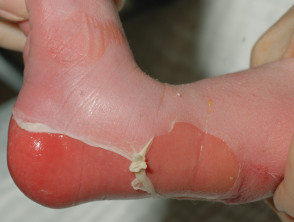
Recessive Dystrophic Epidermolysis Bullosa
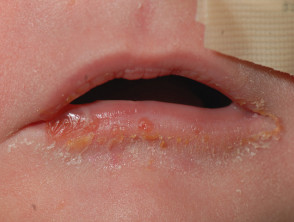
Recessive Dystrophic Epidermolysis Bullosa
¿Cómo se diagnostica la epidermólisis ampollosa distrófica?
In dominant subtypes of epidermolysis bullosa, where an informative family tree is known, clinical diagnosis by a specialist dermatologist based on present signs is often acceptable. dermatologist based on the signs present.
- Diagnostic tests are also available in some countries and include biopsy of a newly induced blister undergoing immunofluorescence antigen mapping (IFM) and/or transmission electron microscopy (EM). Mutation analysis (gene blood test) genes, although currently not considered the first-line diagnostic test, is also available in some countries.
Squamous cell Carcinoma in dystrophic epidermolysis bullosa is diagnosed by its clinical appearance and is supported by biopsy.
¿Cuál es el tratamiento de la epidermólisis ampollosa distrófica?
See treatment of epidermolysis bullosa - general.
- Pruritus (itching) can be a problem for patients with dystrophic epidermolysis bullosa; strategies such as moisturizing and avoiding hot environments can help.
- In dominant recessive dystrophic epidermolysis bullosa (DDEB), care focuses on blister prevention and management. This refers to the skin, but may also include eating soft foods to reduce esophageal reflux blisters.
- In severe recessive recessive dystrophic epidermolysis bullosa (RDEB), great attention is needed for both skin and mucous membranes. Management of pain, pruritus, infection, scarring, and joint, malnutrition, and anemia all play an important role in the daily management of RDEB.
- Squamous cell carcinomas Squamous cell carcinomas are treated surgically. This must be done early, as the tumors are aggressive and have often metastasized by the time of diagnosis. Amputation may be necessary.
¿Cuál es el resultado para los pacientes con epidermólisis ampollosa distrófica?
Life expectancy is unaffected in dominant recessive dystrophic epidermolysis bullosa. In recessive recessive dystrophic epidermolysis bullosa, life expectancy has improved significantly thanks to appropriate management and interventions related to disease complications, including early detection and treatment of squamous cell carcinoma (SCC).