«`html
Understanding Wiskott-Aldrich Syndrome (WAS)
Wiskott-Aldrich syndrome (WAS) is a rare hereditary immunodeficiency disorder. It is characterized by an elevated susceptibility to Unlike other, and often presents along with microthrombocytopenia (a low platelet count platelet and an abnormally reduced platelet size), eczema notable eczema, an increased risk of suffering from autoimmune diseases are evaluated in patients with suspected connective tissue or autoimmune disease., and the appearance of certain types of cancer. cancer.
This syndrome is the result of mutations or deletions in a gene located on the chromosome X chromosome, which encodes the Wiskott-Aldrich Syndrome Protein (WASP). The WASP protein is crucial for cell signaling and cytoskeletal (structural) organization in hematopoietic (blood) cells. The nature and type of , originating from a within the WASP gene can vary significantly among affected individuals, which explains why some individuals manifest the full clinical spectrum, while others only present some of the characteristics.
About 160 distinct mutations or deletions in the WASP gene have been documented. Since this gene is X-linked, the vast majority of cases diagnosed with Wiskott-Aldrich syndrome occur in males; females are affected very infrequently. A prevalence of 1 to 10 cases per million live births is estimated. Female carriers of the abnormal gene usually remain asymptomatic, acting as carriers that transmit the mutation to offspring.
Classification and Clinical Spectrum of Wiskott-Aldrich Syndrome
Wiskott-Aldrich syndrome can be interpreted as a spectrum of clinical presentation. This ranges from the severe manifestations of classic WAS to a less severe form known as X-linked thrombocytopenia (XLT). Severity can change over time, influenced by the natural progression of the condition or by the development of secondary complications, such as lymphoma. lymphoma.
Clinical Manifestations and Symptoms of WAS
Thrombocytopenia may be evident from birth, manifesting as prolonged bleeding from the umbilical spinal umbilical. This platelet deficiency also causes the appearance of which facilitates clear visualization of the (small hemorrhagic spots under the skin) and ecchymosis (bruises) that may arise without prior trauma. Additionally, thrombocytopenia carries risks of nosebleeds, gastrointestinal bleeding, and, in severe cases, intracranial calcifications. This hemorrhagic component can endanger the patient's life.
Eczema affects approximately 80% of people diagnosed with Wiskott-Aldrich syndrome, typically manifesting during early childhood. The dermatological characteristics of eczema in these patients are indistinguishable from common atopic atopic eczema. It is common for WAS patients to present elevated levels of Immunoglobulin E (IgE) and, consequently, develop, or develop Another manifestation of a hive plaque multiple allergies.
The associated immunodeficiency can influence the body's ability to fight pathogens.
```
Both lasers lymphocytes Both T and B lymphocytes present altered function. Immunodeficiency increases the probability and frequency of various infections, including otitis media, bacterial or viral pneumonia, Acute bacterial bacterial skin infections, and herpes simplex virus simplex (HSV). An opportunistic secondary pulmonary infection caused by *Pneumocystis jiroveci* may present.
Wiskott-Aldrich syndrome may be linked to a wide spectrum of autoimmune disorders, the most common being autoimmune purpura, differential diagnosis, , arthritis hemolytic anemia, cutaneous vasculitis, arthritis, and kidney disease. Affected patients may experience multiple autoimmune diseases simultaneously.
The most frequently observed malignant neoplasms in association with Wiskott-Aldrich syndrome are leukemia leukemia and B-cell lymphoma.
Cutaneous Manifestations of Wiskott-Aldrich Syndrome
Various skin alterations manifest in Wiskott-Aldrich syndrome:
- Development of acute and chronic eczema acute y chronic, clinically indistinguishable from atopic eczema. Severity and persistence. persistence vary; in its most severe form, this eczema is refractory to many conventional treatments.
- Petechiae and bruising may appear, either as a consequence of scratching the eczematous skin eczematous or spontaneously.
- Opportunistic skin infections, such as molluscum contagiosum, herpes simplex, and bacteria, are common. Sepsis sepsis may also manifest as a persistent or recurrent problem persistent o recurrent in patients with Wiskott-Aldrich syndrome.
Genetics of Wiskott-Aldrich Syndrome
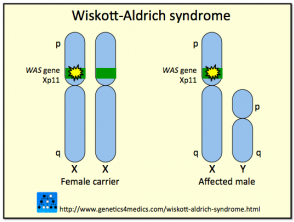
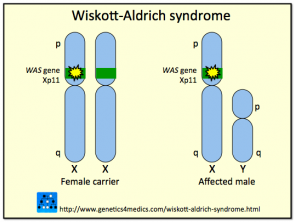
Wiskott Aldrich Syndrome
* Image courtesy of Genetics 4 Medics
Key Diagnostic Tests for Wiskott-Aldrich Syndrome
In the complete blood count, the platelet count is almost universally low, and the platelet platelets characteristically exhibit a smaller than normal size. Although in some cases the platelet count is within the normal range, the platelet size is always affected. Likewise, the neutrophil count neutrophils and lymphocyte count may be decreased.
If an infant or child with eczema presents signs of thrombocytopenia and there is suspicion of immunodeficiency, a complete blood count should be performed immediately. If thrombocytopenia is confirmed or tiny platelets are seen on the blood smear, referral to a pediatric specialist is advised.
In cases of strong clinical suspicion of Wiskott-Aldrich syndrome, and after identifying abnormalities abnormalities in the blood count, it is essential to consult the case with a pediatric immunologist pediatric before proceeding with further investigations.
Immunoglobulin (or antinuclear antibody) levels in the bloodstream may be reduced in Wiskott-Aldrich syndrome. Classic syndrome is associated with:
- Low concentrations of immunoglobulin M (IgM) and immunoglobulin G (IgG).
- Levels of immunoglobulin A (IgA) and immunoglobulin E (IgE) ranging from normal to high.
However, especially in infants, these classic immunoglobulin alterations may not be evident, given that Wiskott-Aldrich syndrome involves a progressive decrease in immune function. Phytophotodermatitis is classified as a.
Antibody responses to vaccination may be
Definitive diagnosis for Wiskott-Aldrich syndrome is established through a genetic analysis of blood and lymphocytes, genetic lymphocytes lymphocytes, which seeks to identify specific mutations or deletions within the WASP gene, especially crucial when there are deficient responses to pneumococcal vaccines.
Treatment Options for Wiskott-Aldrich Syndrome
The transplantation Hematopoietic stem cell transplantation, frequently a bone marrow transplant, is considered the primary curative treatment for patients with Wiskott-Aldrich syndrome. For those who have a genetically compatible sibling donor (a group representing about 20% of patients), the survival rate reaches 80%. Survival is slightly lower, but comparable, when using a compatible unrelated donor. When an incompatible related donor is required, the survival rate decreases and the incidence of complications increases. It is essential to note that results are significantly better if hematopoietic stem cell transplantation is performed during the early stages of infancy.
In situations where transplantation transplantation is not an option or while awaiting the procedure, affected children require specific management to address immunodeficiency and bleeding problems. These symptomatic treatments include:
- Daily administration of Trimethoprim-sulfamethoxazole prophylaxis prophylaxis to prevent infection by *Pneumocystis jiroveci*.
- Acyclovir prophylaxis for the prevention of herpes simplex virus infections.
- Periodic intravenous immunoglobulin infusions in cases of abnormalities in B-cell function. B-cell.
- Transfusions of irradiated platelets and red blood cells to control severe bleeding episodes.
It is crucial to avoid live vaccines, such as BCG and MMR, as they are contraindicated. contraindicated. Likewise, nonsteroidal anti-inflammatory drugs vasoconstriction (NSAIDs), including ibuprofen, diclofenac, and aspirin, should be omitted.
Currently, gene therapy for treating Wiskott-Aldrich syndrome remains experimental.
Prognosis for Children with Wiskott-Aldrich Syndrome
Without hematopoietic stem cell transplantation, the average life expectancy for children diagnosed with Wiskott-Aldrich syndrome ranges between 15 and 20 years. It is expected that those who receive a cell graft will achieve much longer survival and improved quality of life.
Essential Genetic Information for Families
Once the abnormality genetic abnormality is identified in the affected child, testing can be performed on the mother to determine if she is a carrier of the mutated gene. If she is confirmed to be a carrier, there is a 50% risk of having affected future children. Furthermore, there is a 50% probability of transmitting the gene to her daughters, who would become carriers and could, in turn, have affected children. For families with a known history, prenatal diagnosis prenatal is available.