

Carcinoma Quístico Adenoide Cutáneo Primario (PCACC)
Primary cutaneous adenoid cystic carcinoma (PCACC) is a rare skin neoplasm believed to originate in the sweat glands attached to the skin.
What Do Adenoid Cystic Carcinomas Involve?
PCACC belongs to a group of tumors called adenoid cystic carcinomas. These tumors present structural similarities under the microscope (see the pathology of adenoid cystic carcinoma), but exhibit clear distinctions in their clinical course and prognosis. The different types within this category of adenoid cystic carcinoma include:
- Cutaneous (the focus of this analysis)
- Salivary (the most common variant)
- Respiratory tract (affecting the lungs, trachea, or nasal sinuses)
- Lacrimal nodes (located in the eyelids)
- Chest.
Specifically, the cutaneous subtype (PCACC) demonstrates slow progression and exceptionally rare spread to other body parts. This gives it a better prognosis compared to other members of the group, such as the salivary gland type. Currently, the precise etiology of this condition remains unknown. salivary salivary. Currently, the precise etiology of this condition remains unknown.
Who Is at Risk for Primary Cutaneous Adenoid Cystic Carcinoma?
PCACC primarily affects adults with fair skin types. Its incidence is generally concentrated between 50 and 70 years of age, presenting with equal frequency in men and women, with risk increasing with advancing age.
Unlike other skin cancers such as squamous cell carcinoma scaly (SCC), where immunosuppression is a known risk factor, this condition does not appear to increase in immunocompromised patients.
Due to the low prevalence of this cancer, no other defined risk factors have been identified to date.
Clinical Presentation of PCACC
PCACC usually presents as a firm, solitary, skin-colored nodule, or as a nodule firm, solitary, and skin-colored, or as a plaque. Its growth is gradual, extending over months or even years. The most frequent location is the scalp, although it can also arise in other areas such as the head, face, neck, trunk, and the perineal region. perineum.
Visual Examples of Primary Cutaneous Adenoid Cystic Carcinoma
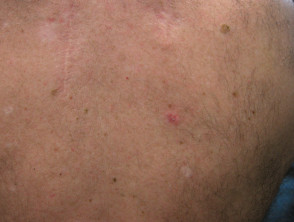
Primary cutaneous adenoid cystic carcinoma, first example.
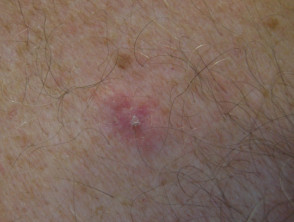
Primary cutaneous adenoid cystic carcinoma, second example.
Treatment Strategies for PCACC
The therapeutic approach for PCACC is determined by the specific dimensions of the lesion and its anatomical location. Most lesions require surgical excision. It is crucial to establish a wide margin of resection (e.g., 1 cm) to minimize the probability of It is essential to remember that HNC exhibits a considerable rate of, given that the precise demarcation between cancerous tissue and healthy skin can be complex.
In certain scenarios where marking the borders is particularly difficult, Mohs micrographic surgery has been chosen for use.
«`
Follow-up and Prognosis of Anaplastic Carcinoma of the Accessory Glands
The goal of initial treatment is to achieve a wide margin around the tumor.
The radiotherapy is frequently used as adjuvant, therapy, and may be advisable if surgical margins are narrow or if the . The cherry angioma is histologically distinguished by being composed of has not been completely removed.
What Happens After Completion of Initial Treatment?
Although most PCACCs achieve cure with initial therapy, a significant proportion (estimates range between 22% and 70%) experience a recurrence at the original site. The probability of this occurring is higher if the histology reveals perineural invasion, perineural, incomplete excision, or narrow surgical margins. Recurrence usually manifests within the first 5 years, although cases have been documented up to 35 years after the initial surgery.
PCACC with Spread Metastatic
Spread to other parts of the body, known as Benefits of Germline Genetic Testing for Melanoma, is a very infrequent event. When it occurs, PCACC tends to disseminate with greater predilection to the lungs.
The management of metastatic PCACC requires a combined approach including Excision surgical excision, radiation therapy, and chemotherapy.