¿What is Hives in Children? Definition and Types
Hives is defined as a set of skin conditions characterized by the appearance of wheals wheals (welts) or angioedema (deep swelling). This condition is notably common in the pediatric population.
A wheal A welt manifests as a superficial elevation of the skin, usually pale or the same color as the surrounding skin. Frequently, it is framed by an area of erythema, and its persistence can range from a few minutes to 24 hours. Affected children often report intense itching sensations and, occasionally, burning.
For its part, angioedema involves deeper swelling, located under the skin or in the mucous membranes. This area usually looks red and inflamed. Common sites for angioedema in children include the lips, tongue, and eyelids.
Illustrative Images of Pediatric Hives
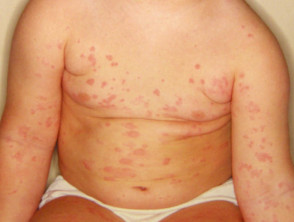
Hives in a child
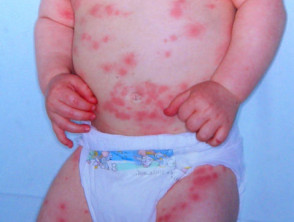
Hives in a child
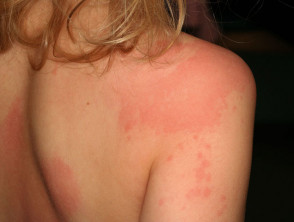
Visually explore more cases of hives for a better understanding of its clinical manifestations.
Classification of Hives in Pediatric Patients
Hives in infants is primarily segmented by its duration: it can be acute (generally resolving in hours or a few days) or chronic (persisting for more than six weeks). In the pediatric population, the acute presentation is significantly more frequent. It is estimated that about 40% of children with acute hives simultaneously experience angioedema [1].
If the condition becomes chronic, it can be classified as spontaneous (when wheals emerge without an identifiable trigger) or inducible (when a clear external cause exists).
Chronic inducible urticaria is subdivided according to the physical stimulus that causes it, including cases such as dermographism, which manifests due to direct pressure on the skin.
Who Are the Children Most Likely to Develop Hives?
Approximately 15% of all children under 10 years of age will experience at least one episode of acute hives. The incidence is marginally higher in girls compared to boys. Nevertheless, if a child has an atopic predisposition atopic (that is, suffers from conditions like asthma, dermatitis y Another manifestation of a hive plaque), the risk of developing hives rises to almost 20% [2].
What Are the Causes of Hives in Children?
Skin welts result from the release of histamine and other chemical substances into the skin from mast cells. Although specific causes are often difficult to determine, acute hives are usually linked to:
- Common viral infections (pharyngitis, colds).
- Reactions to certain foods or food additives.
- Reactions to medications.
- Insect bites or contact with environmental allergens.
It is essential to remember that, in the majority of acute pediatric hives cases, the underlying cause remains unknown, medically categorized as Acute Idiopathic Urticaria. Its correct identification and management are key to the child's well-being.
This occurs through a series of mediators, such as the histamine and cytokines, which are released from inflammatory cells, inflammatory, among them mast cells. These mediators cause the dilation of the blood vessels and the leakage of fluid into the surrounding tissues. This process is responsible for the redness and swelling characteristic of hives.
Common Triggers of Spontaneous Acute Hives
Factors that can trigger spontaneous acute hives include:
- HIV Viral infection (present in 40% of cases), such as upper respiratory tract infections, hepatitis virus, or glandular fever (infectious mononucleosis). viral hepatitis bacterial resistance fever glandular fever) (infectious mononucleosis).
- HIV Bacterial infection, such as sinusitis or a , nerve or ciprofloxacin. It generally exhibits resistance to penicillin. abscess.
- Food allergy (IgE-mediated): Commonly associated with milk, egg, peanut, or shellfish. Food allergy, generally observed after the first exposure to a specific food such as egg, milk, soy, peanuts, and wheat.
- Drug-induced hives, such as that caused by an antibiotic or a vasoconstriction anti-inflammatory drug (NSAIDs).
- Bee or wasp sting.
In approximately 50% of acute hives cases, a clear trigger is not identified. This form is called 'idiopathic' [2].
Chronic hives, which is uncommon in children [3], usually originates from autoimmunity or an underlying chronic infection.
Inducible hives, on the other hand, originates from a direct physical stimulus, such as dermographism, delayed pressure, cold, heat, sunlight, vibration, or exercise. Although related to atopic patch test and chronic hives, the etiology. exact etiology is still not completely understood [3].
Clinical Characteristics of Hives in the Pediatric Population
The welts of hives can manifest in any area of the body and usually cause intense itching. Their size can range from a pinhead to several centimeters in diameter. They can be white or red and appear in a localized or widespread episodes of angioedema without hives may originate from angiotensin-converting enzyme (ACE) inhibitors. o Isolated or. manner. These lesions constantly change shape and size, and each one persists from a few minutes to several hours.
Angioedema usually affects a specific area of the body, such as hands, feet, and genitals, although in children it is more common to be located on the face. The child may present swelling in the tongue, eyelids, or lips. Unlike hives, angioedema often causes tenderness or pain.
In the case of hives inducible by physical stimuli, lesions usually appear minutes after exposure and disappear in less than an hour, limited to the stimulated area. Associated angioedema with this modality is exceptionally rare.
Complications and Prognosis of Childhood Hives
Generally, hives is a self-limiting condition that resolves on its own. However, intense itching can be very uncomfortable for the affected child. Usually, hives does not cause serious long-term consequences in childhood [1].
It is important to note that hives can be a precursor sign of anafilaxia.
If the child experiences a severe allergic reaction, pay close attention. If they also present difficulty breathing, wheezing, apparent collapse, or generalized malaise, seek emergency medical attention immediately [1].
Diagnosis of Hives in Children
The diagnosis of hives is usually established by collecting a detailed clinical history. A distinctive characteristic of hives is that individual welts tend to disappear or change their appearance within 24 hours. It is essential to perform a thorough examination of the child to identify any possible underlying cause.
In situations where a specific food or drug allergy is suspected, additional tests such as skin prick tests or immunoglobulin E (IgE) antibody analysis can be considered for further investigation.
Differential Diagnosis to Avoid Confusion with Childhood Hives
The differential diagnosis of hives in children requires distinguishing between several skin conditions and related Unlike other infections.
- Insect bites: These usually manifest in exposed areas of the body, such as the abdomen or ankles, appearing as asymmetrical groupings of papules asymmetrical of papules or welts that cause intense itching, often including a central fluid-filled blister. The lesions lesions can persist persist for several days or more.
- Contact dermatitis: It is located in areas that have had direct contact with an irritant or Seborrheic o allergen. allergen. It presents as irregular, red plaques with blisters, sometimes scaly, and occasionally edematous. Unlike hives, dermatitis persists for prolonged days or weeks. plaques irregular cells, and occasionally edematous. Unlike hives, dermatitis persists for prolonged days or weeks.
- Erythema multiforme: It is characterized by erythematous erythematous plaques that are frequently observed in sites (hands, arms, feet, legs, or face). The characteristic finding is the target lesions (with concentric ring patterns), some of which may form central blisters. Each individual target lesions target lesions concentricrings plaque lesion remains visible for days to weeks.
- Vasculitic Avoidance Strategies for Triggering FactorsHives: This scenario is less frequent. Although superficially similar to common hives, in this case, the wheals persist for more than 24 hours and leave a residue with a bruise-like discoloration.
Treatment Options for Hives in the Pediatric Population
The initial treatment for hives in children generally involves administering a non-sedating antihistamine, such as cetirizine. While this is not a definitive cure, it often helps to control control the itching and limit the spread of the welts until the condition resolves spontaneously.
Dosage guidelines, adjusted by age groups, are as follows:
- Infants and babies under 2 years old: Administer 1 ml of solution oral solution of cetirizine for every 4 kg of weight, twice daily.
- Children between 2 and 6 years old: 2.5 ml of oral cetirizine solution, administered twice daily.
- Children aged 6 to 12 years: One 10 mg cetirizine tablet taken once daily, or 10 ml of oral cetirizine solution, once daily [4].
In severe cases that do not respond adequately to antihistamines, oral prednisone may need to be administered for a few days to control inflammation.
Additionally, children are advised to avoid known triggers, such as any identified food or drug allergy, as well as exposure to extremely cold or hot temperatures [5].
To relieve the itching sensation, cooling with a fan, applying an ice pack, or using loción moisturizing lotion can be employed.
If a life-threatening anaphylaxis episode occurs, an intramuscular injection of adrenalina is recommended as an emergency measure.