
¿What is Gardner Syndrome?
Gardner syndrome is a variation of familial adenomatous polyposis (FAP), a hereditary condition distinguished by the appearance of gastrointestinal polyps, multiple osteomas (benign bone tumors), and tumors in the skin and soft tissues. Polyp formation generally begins during puberty, with an average age of diagnosis around 25 years. Early detection is crucial, as in almost all patients, these polyps progress to malignancy, irreversibly culminating in colorectal cancer.
Genetic Causes of Gardner Syndrome
The etiology of Gardner syndrome lies in specific mutations located in the APC, gene, situated on chromosome 5q22. This gene plays an essential role in tumor suppression. The inheritance pattern of Gardner syndrome is an autosomal dominant trait, meaning an affected individual has a 50% probability of passing the mutated gene to each of their offspring.
Genetics of Gardner Syndrome *
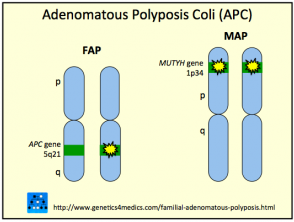
Gardner Syndrome
* Image courtesy of Genetics 4 Medics
Clinical Manifestations of Gardner Syndrome
The clinical manifestations of Gardner syndrome are categorized into cutaneous and non-cutaneous findings. The most distinctive dermatological feature is the presentation of epidermoid cysts. These cysts can be distinguished from common epidermoid cysts based on the following criteria:
- Epidermoid inclusion cysts associated with Gardner syndrome (present in 50-65% of cases) usually manifest at an earlier age, specifically around puberty, than typical epidermoid cysts.
- The location of epidermoid cysts in Gardner syndrome frequently occurs in unusual areas such as the scalp, face, and extremities, unlike the more common sites for ordinary cysts.
- More than half of patients with Gardner syndrome develop multiple cysts.
- As with conventional epidermoid cysts, these are usually asymptomatic; however, they can become pruritic (cause itching), inflamed, or rupture.
- Occasionally, these cysts exhibit hybrid characteristics observed in the histopathology of pilomatricomas.
Other reported cutaneous manifestations include the presence of desmoid cysts.
Includes manifestations such as fibromas, lipomas, leiomyomas, neurofibromas y lesions or pigmented of the skin.
Characteristics that do not affect the skin include:
- Gastrointestinal polyps, which almost always progress to colon adenocarcinoma (colorectal cancer).
- Osteomas: these benign bone tumors are crucial for establishing the diagnosis of Gardner syndrome. They are most frequent in the maxilla (jawbone), although they can also develop in the skull and long bones.
- Dental anomalies: in addition to mandibular osteomas, other dental alterations may be present, such as unerupted supernumerary teeth and cavities.
- Multifocal pigmented fundus retina: observed in 80% of patients. These lesions can be present shortly after birth and constitute the first indicator of the disease.
Diagnosis of Gardner Syndrome
Gardner syndrome is diagnosed by identifying the following clinical and genetic manifestations:
- Having $\geq 100$ colorectal polyps OR $\leq 100$ polyps along with a family member diagnosed with familial adenomatous polyposis or Gardner syndrome.
- Presence of osteomas.
- Soft tissue tumors, such as epidermoid cysts, fibromas, and desmoid tumors.
- Detection of a , originating from a in the APC.
Radiological studies are fundamental for both patients and their relatives suspected of having Gardner syndrome.
- Bone imaging can reveal the presence of osteomas in long bones.
- Early mandibular radiographs may show subtle defects in bone structure.
- Early ophthalmological exams are necessary to detect pigmented fundus lesions.
- It is recommended to perform a colonoscopy and other invasive tests to monitor polyp development every one or two years.
Treatment Options for Gardner Syndrome
Treatment for epidermoid cysts associated with Gardner syndrome is analogous to that used for common cysts, generally involving removal surgical excision. Occasionally, if the cysts are inflamed, intralesional steroid injections may be administered.
Given the high probability that gastrointestinal polyps will progress to cancer, surgical resection of these is recommended. It is imperative that patients maintain a schedule of periodic colonoscopies.
Osteomas may also require excision, although this is reserved for cases where they cause significant deformity or result in a source of functional or aesthetic discomfort.
Comprehensive management of Gardner syndrome requires continuous surveillance and timely intervention for clinical manifestations to prevent serious complications, especially the development of colorectal cancer.