Understanding Ectodermal Dysplasia: Definition and Classification
The ectodermal dysplasia constitutes a vast group of hereditary conditions manifested by a primary defect affecting the hair, teeth, and nail or the function of the sweat gland (salivary). Additionally, these conditions involve other abnormalities in any tissue derived from the ectoderm. This origin includes structures such as the ears, eyes, lips, the mucous membranes membranes of the oral or nasal cavity, as well as the central nervous system.
The ectoderm represents the outermost cell layer during embryonic development development, being fundamental in the formation of multiple body parts, including those already mentioned. Ectodermal dysplasia arises when this ectodermal layer in specific areas fails to develop develop properly. It is crucial to understand that all forms of ectodermal dysplasia are present from birth and are not progressive conditions. Seborrheic dermatitis most commonly affects the scalp and facial region, frequently associated with.
Classification of Ectodermal Dysplasia
Currently, nearly 150 distinct varieties of ectodermal dysplasias have been identified. To systematize them, subgroups have been established based on the presence or absence of the four primary defects of ectodermal dysplasia (ED):
- ED1: Trichodysplasia (hair dysplasia or hair defect)
- ED2: Dental dysplasia
- ED3: Onychodysplasia (nailnail dysplasia)
- ED4: Hidrosis disorder (sweat gland dysplasia)
Using these four fundamental defects as a basis, the approximately 150 types of ectodermal dysplasias are grouped into the following subgroups composed of the combination of primary defects:
- Subgroup 1-2-3-4
- Subgroup 1-2-3
- Subgroup 1-2-4
- Subgroup 1-2
- Subgroup 1-3
- Subgroup 1-4
- Subgroup 2-3-4
- Subgroup 2-3
- Subgroup 2-4
- Subgroup 3
- Subgroup 4
The most frequently diagnosed variants of ectodermal dysplasia are hypohidrotic ED (or anhidrotic), classified within subgroup 1-2-3-4, and hidrotic ED, which is located in subgroup 1-2-3.
The three ectodermal dysplasia syndromes that enjoy the greatest clinical recognition belong to subgroup 1-2-3-4, as they exhibit manifestations of the four primary defects. These syndromes include:
- Ectrodactyly-Ectodermal Dysplasia-Cleftclefting
- Hypohidrotic Ectodermal Dysplasia Rapp-Hodgkin
- Ankyloblepharon, Ectodermal Defects, Lip/Palate Cleft (AEC) or Hay-Wells Syndrome
Prenatal testing is currently available to diagnose some ectodermal dysplasia syndromes in certain specialized centers.
What Causes Ectodermal Dysplasia?
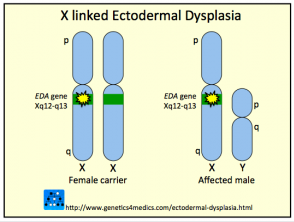
The various types of ectodermal dysplasia are triggered by a , originating from a or the deletion of genes specific genes located on different sex. chromosomes. Since these conditions have a basis in a genetic defect genetic, there is a possibility that they are inherited or transmitted through family lineages. However, sometimes they can manifest in individuals without a prior family history, indicating the occurrence of a de novo mutation. de novo.
Genetics of Ectodermal Dysplasia *
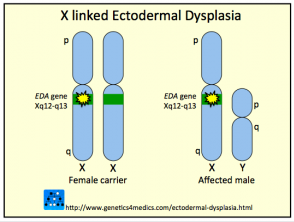
Ectodermal Dysplasia
*Image courtesy of Genetics 4 Doctors
Clinical Manifestations of Ectodermal Dysplasia
The clinical presentation of ectodermal dysplasia varies significantly among the different types and depends directly on the primarily affected ectodermal structures. Generally, signs and symptoms are not visible at birth; instead, they usually become evident during infancy or early childhood.
Symptoms of Anhidrotic Ectodermal Dysplasia
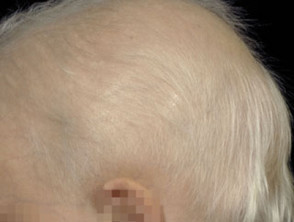
Anhidrotic ectodermal dysplasia
Ectodermal dysplasia typically affects four main organ groups, manifesting in the following specific ways:
| Affected Organ | Clinical Characteristics |
|---|---|
| Hair |
|
| Nails |
|
| Teeth |
|
| Sweat Glands |
|
Additionally, patients may present other symptomatic manifestations:
- The skin may have light pigmentation pigmentation, although in some cases a in the skin include several biochemical processes: red or brown pigment may be observed. The skin on palms and soles tends to thicken, becoming prone to fissures, bleeding, and infection.
- The general skin may be dry and susceptible to rashes rashes.
- Dry eyes are usually present due to insufficient tear production. Cataracts cataracts and other visual defects are also possible.
- Abnormalities in ear development often lead to hearing problems.
- Cleft palate or cleft lip is possible.
- Underdevelopment or partial absence of fingers or toes (digits,).
- The Unlike other Respiratory infections may be more common due to the lack of normal protective secretions in the mouth and nose.
- A foul-smelling nasal discharge may manifest.
Understanding these manifestations is crucial for early diagnosis and comprehensive management of the various forms of ectodermal dysplasia.
- Discharge Nasal discharge from chronic nasal infections. Malignancy..
- Absence or underdevelopment of the mammary glands.
Treatment Options for Ectodermal Dysplasia
Currently, there is no single specific treatment for ectodermal dysplasia. The main focus is the symptomatic and multidisciplinary management of the various manifestations of the condition. Therefore, patients usually require collaboration from a broad team of medical and dental specialists, rather than relying on a single provider.
- Individuals with abnormal or absent sweat gland function should seek cooler environments or ensure they have air conditioning systems in their homes, schools, and workplaces. The use of cold water baths or applying cool mists can be beneficial for maintaining a stable body temperature.
- For those with deficient tear production, the use of artificial tears is recommended to prevent damage to the infiltrates. cornea. Saline sprays (Saline) also offer useful relief.
- Nasal irrigation with saline solution is crucial to clean the mucosa of debris purulent residue and mitigate the risk of secondary infections.
- Dental intervention and evaluation should be carried out early.
- Surgical corrections, such as cleft palate repair, can reduce joint structural.
- deformities and improve speech ability.
The use of wigs can be a strategy to improve appearance in patients with significant or total alopecia. mucosa (abnormalitiesMost people diagnosed with ectodermal dysplasia can achieve a full and productive life once they adequately understand and manage their condition. It is essential to closely monitor children, especially if they present with recurrent fevers accompanied by abnormalities in sweating or mucus production (abnormalities). Sudden and repeated increases in body temperature can trigger seizures and serious neurological complications.