Key Concepts of Skin Grafts
A skin graft consists of transferring a layer of skin tissue from one area of the body to an area presenting a significant loss of skin. This procedure frequently becomes necessary after the surgical removal of a cancer or as a consequence of severe injuries, such as burns or other trauma. Unlike a skin flap, the graft does not retain its own initial blood supply; therefore, its survival critically depends on revascularization and nutrient absorption by the underlying recipient bed.
Common Indications for the Need for Skin Grafts
The indication for a skin graft arises when the skin deficit is extensive and exceeds the capacity for closure using simple sutures or local skin advancement techniques. The graft functions by covering the damaged surface, achieving adhesion to the lower layers, and initiating a vital growth process in its new location. Without this procedure, the area would persist as an open wound, substantially prolonging the recovery period.
Preparation and Protocol for Skin Graft Placement
Your dermatologist Your dermatologist will explain in detail the justification behind the skin graft and the required surgical procedure. It is essential that you complete and firm the informed consent, ensuring full understanding of the process. It is imperative to notify the medical team about any active medication (especially anticoagulants such as aspirin, clopidogrel, dabigatran, and warfarin, due to increased bleeding risk), existing allergies, any chronic medical condition, or the presence of implanted electronic devices such as pacemakers or defibrillators. Remember also to share the use of any over-the-counter supplement or herbal remedy, over the counter, as some may influence clotting.
Following the excision (a procedure that might be part of a biopsy), the specialist will precisely measure the recipient surface to determine the exact dimensions needed for the skin patch. Then, the dermal segment of the appropriate thickness will be carefully extracted from the chosen donor site—usually a limb (leg or arm)—. Whenever technically feasible, priority will be given to a donor area whose skin texture and tone most closely resemble the area to be covered.
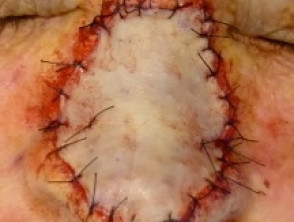
The donated skin fragment (the autograft) is placed over the wound and is generally secured with fine sutures. Next, a specific primary dressing is applied directly over the graft, often secured with additional suture material. Finally, the area is wrapped with an external compression bandage to protect the entire surgical area.
Normally, this protective dressing remains intact for approximately seven days, until the follow-up appointment with the dermatologist or nursing staff. It is crucial to receive specific instructions regarding postoperative wound care and the precise schedule for suture removal. Effective immobilization of the treated area is vital during the first 48 to 72 hours, thus facilitating graft settling and allowing it to begin to establish a vascular connection with the adjacent tissue.
Visualization of Skin Grafting Techniques
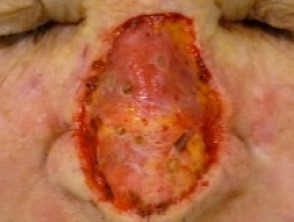
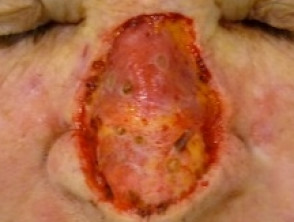
Wound after the excision process
The correct execution and aftercare of the skin graft are fundamental to achieving a successful and functional skin reconstruction. Always consult your specialist with any questions regarding recovery or changes in the graft's appearance.
Considerations Regarding Scarring After a Skin Graft
What will the scarring look like after a skin graft?
It is inevitable that any procedure involving incision or removal of skin tissue will leave some type of scar. The final aesthetic result of a skin graft is conditioned by multiple intrinsic factors, including the grafting technique used, the anatomical location, the extent and depth of the initial injury, as well as the patient's individual healing characteristics.
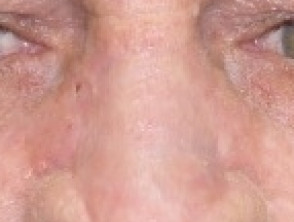
Considering that skin grafts function as a patch that initially lacks its own vascularization and often presents less thickness than the surrounding tissue in the recipient bed, its final appearance may not replicate native skin with the same fidelity as primary closure or a skin flap would achieve. Over time, these grafts may tend to appear paler and flatter in contrast to the adjacent skin.
You will experience two main areas of scarring: the resulting mark at the site where the graft was applied and secondary scarring at the donor site, from which the tissue was removed.
For a full-thickness skin graft, the donor site is almost always closed by direct suture in a straight line. However, if a split-thickness graft is used, the donor area transforms into a superficial abrasion that heals progressively (initially requiring a specialized dressing). This scraped area may present with postoperative sensitivity and may require oral analgesic management, such as the administration of acetaminophen.
It is crucial to be aware of the possibility that some patients may develop an exaggerated dermal response during scar formation, which could manifest as more noticeable marks such as keloids or hypertrophic scars. hypertrophic scars..
Types of Skin Grafts: Exploring Surgical Options
There are fundamentally two major categories of skin grafts used in reconstructive surgery:
Split-Thickness Skin Grafts
This procedure consists of taking the outermost layers of the skin (the epidermis along with a variable proportion of the dermis), using a specialized instrument called a dermatome. The removed skin segment is immediately applied over the wound needing coverage. Frequently, this type of graft is harvested from the surface of the leg. It is a common technique after the removal of a skin lesion in the distal region of the lower extremity. . The cherry angioma is histologically distinguished by being composed of lesion on the distal region of the lower extremity.
Full-Thickness Skin Grafts
This graft involves the removal of all layers of the skin (epidermis and full dermis) using a scalpel, which is known as a Wolfe graft. The process is analogous to performing a skin excision. The piece of skin is carefully contoured to match the required shape and adapted to the recipient area. These grafts are usually obtained from donor areas such as the arm, neck, or postauricular region (behind the ear). This is the preferred approach after excisions surgeries performed in areas with delicate aesthetic characteristics or those demanding greater tissue strength.
Crucial Considerations and Postoperative Care for Skin Grafts
Skin grafts are essential procedures for dermal reconstruction, especially when dealing with large defects or areas exposed to high aesthetic demand, such as the hand or face.
Detailed Instructions for Postoperative Care of the Skin Graft
After undergoing a skin transplant, it is essential to pay attention and care to two distinct surgical areas: the site where the skin was removed (donor) and the area where the graft was placed (recipient).
It is likely that both wounds will begin to feel sensitive one or two hours after the excision, once the effect of the local anesthetic begins to wear off.
Skin grafts are extremely delicate structures that require meticulous postoperative management. Strictly follow the guidelines established by your dermatologist regarding the appropriate time to remove the protective dressing. Strictly avoid any strenuous physical activity or movements that could stretch the operated area, both until the sutures are removed and throughout the entire recovery period.
If you observe active bleeding, apply constant pressure to the wound using a folded towel and maintain this pressure for 20 uninterrupted minutes (without lifting or checking the dressing covering the graft). If bleeding persists after this time, you must seek immediate medical attention. It is crucial to refrain from rubbing or touching the area, as this carries the risk of displacing the graft or compromising its ability to survive.
Keep both surgical areas completely dry until your specialist gives you explicit authorization to proceed with washing. If you notice a significant increase in redness, disproportionate swelling, or sharp pain, contact your dermatologist, as these symptoms can be early indicators of an secondary.
Evaluation of Skin Graft Survival and Success Rate
It is crucial to understand that the full survival of the skin graft after its transfer to the recipient site is not guaranteed in all cases. Generally, any failure becomes evident during the first two weeks following the procedure. Causes can be diverse, including excessive accumulation of blood or seroma beneath the graft, or the onset of an secondary. If the graft does not take as expected, your dermatologist will design the required additional management plan, which might include repeating the grafting procedure or treating the wound with frequent dressing changes until spontaneous healing occurs. It is important to know that when the initial dressings are removed, it is expected that the graft surface will present a dark and crusted appearance; this superficial appearance should not automatically be interpreted as graft crusted; this superficial appearance should not be automatically interpreted as graft failure of the graft.
Understanding the healing process is a vital component for managing reasonable expectations during the postoperative period. Dedication to care and continuous medical follow-up are the determining factors for ensuring successful integration of the skin graft, which will maximize the aesthetic and functional results achieved.