Understanding Shingles: Causes, Symptoms, and Clinical Features
Definition and Nature of Shingles
Shingles (herpes zoster) is a localized condition, manifested by a painful blister rash, caused by the reactivation of the varicella-zoster virus (VZV). A distinctive characteristic of shingles is its distribution in a dermatome specific dermatome, which means that the skin lesions are confined to the innervation of one or two Mucosal and Follicular Manifestations of Lichen Planus nerves sensory nerves. Typically, this manifestation is unilateral, presenting a clear border at the anterior and posterior midline anterior y posterior of the body.
Commonly known as shingles, herpes zoster is caused by VZV, a double-stranded DNA virus belonging to the order Herpesvirales. DNA of double-stranded DNA belonging to the order Herpesvirales.
Within the affected area, a painful rash blistering rash develops, limited to the cutaneous territory cutaneous of a specific group of nerves, following its distribution sensory distribution.
Risk Factors and Affected Population
Anyone who has had chickenpox (primary primary infection by VZV) has the potential to develop shingles later. or develop later. Although it can manifest in childhood, its prevalence increases significantly in older adults. People with various forms of cancer cancer face an increased risk of approximately 40% of developing developing shingles. Fortunately, recurrence is uncommon; the probability of experiencing a second episode of shingles is estimated to be around 1%.
Generally, shingles tends to affect individuals whose immunity is compromised.
Etiology and Reactivation Mechanism
Following the initial secondary infection from chickenpox, VZV establishes a latent state within the cells of the dorsal root ganglia nerve optic ganglia of the dorsal in the spinal column. It remains inactive for years until it reactivates, migrating through the sensory nerves to the skin to cause the shingles outbreak.
The exact mechanism that triggers reactivation in a specific nerve fiber is not always evident. However, certain factors have been identified that can act as triggers:
- Application of direct pressure on the nerve roots.
- Radiation therapy Radiotherapy applied locally at the level of the affected nerve root.
- Surgical intervention at the spinal level.
- An acute infectious episode.
- Suffering a physical injury, not necessarily located on the back.
- Having had recent contact with an active person with chickenpox or shingles.
Clinical Presentation and Evolution of Symptoms
The clinical symptomatology of shingles varies depending on the patient's age, general health status, and the dermatome dermatome that is affected.
The first sign The first sign that shingles is developing is frequently a painful sensation, which can be significant, associated with one or more sensory nerves. This initial pain can be strictly localized to one area or radiate to other areas. It is common for the patient to show general malaise, accompanied by fever fever nerve lymph Lymph nodes.
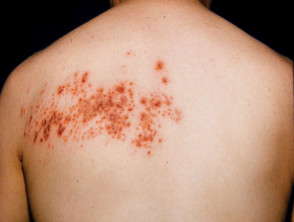
One to three days after the pain begins, the affected area of the skin develops a vesicular rash. The process begins with a coalescence of erythematous papules. papules papules. New lesions.
lesions continue to appear. The rash develops over several days along the distribution of the affected nerve, each lesion progressing from vesicular to pustular and finally crusting. pustular pustular and, finally, forming crusts. crusts.
The areas most frequently affected at all ages are the chest (thoracic), the neck (cervicalcervical), the forehead (ophthalmic), and the regions innervated by the lumbar/sacral sensory nerves. The incidence of ophthalmic shingles increases with age. Occasionally, shingles causes blisters inside the mouth or ears, and it can also manifest in the genital area. Sometimes, pain occurs without a rash (shingles "sine eruptione") or a rash without pain, which is more common in children.
Both the pain and systemic symptoms gradually decrease as the rash rash disappears. In uncomplicated cases, recovery is usually complete in two to three weeks for children and young adults, and in three to four weeks for older patients.
Images of Herpes Infection
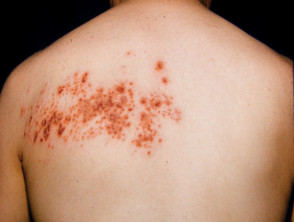
Herpes Infection
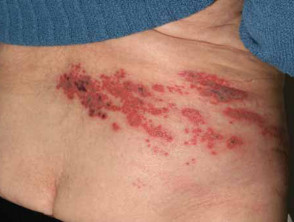
Herpes Infection
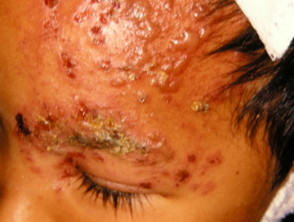
Herpes Infection
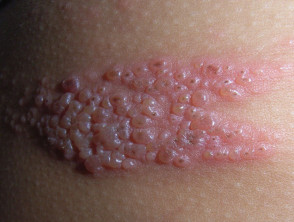
Herpes
Explore more visualizations of shingles cases to better understand its progression.
Potential Complications of Shingles
Shingles can lead to several significant complications:
- Affectation of multiple dermatomes or, less commonly, bilateral. rashes bilateral rashes.
- When the ophthalmic division of the fifth cranial nerve is compromised, serious ocular complications can arise.
- Development of deep blisters resulting in tissue destruction, taking weeks to heal and leaving behind scarring sequelae.
- Approximately one in twenty patients may experience muscle weakness. Facial nerve paralysis is the most common sequela (see syndrome Ramsay Hunt syndrome). There is a 50% probability of full recovery, although almost all cases show some improvement.
- Infection of internal organs, including the gastrointestinal tract, lungs, and even the brain (encephalitis).encephalitis).
Although it is an infrequent event, shingles infection during the first few months of pregnancy could theoretically harm the fetus. However, there is a possibility that the fetus contracts chickenpox in the later stages of pregnancy and develops shingles during its childhood.
Postherpetic Neuralgia: Description and Symptoms
Postherpetic neuralgia is defined by the persistence or reappearance persistence. o It is essential to remember that HNC exhibits a considerable rate of of pain in the same affected dermatome, lasting for more than one month after the resolution of the initial shingles outbreak. Its prevalence increases significantly with age, affecting approximately one-third of patients over 40 years old. The risk is especially high if the initial infection involved the facial area. This pain can manifest as a constant burning sensation along with extreme tactile hypersensitivity in the affected areas, or as episodes of stabbing, spasmodic pain. The underlying skin may feel numb or, paradoxically, hypersensitive. In some cases, the predominant symptom is not pain, but a persistent neuropathic persistent pruritus itching neuropathic symptoms..
nature.
Treatment Options for Shingles antiviral antibodies.. Shingles treatment primarily focuses on the administration of antiviral medications efficacy . If started within the first 24 to 72 hours of symptom onset, they can mitigate the intensity and duration of the pain. Acyclovir is commonly prescribed at doses of 800 mg five times a day for seven days; valacyclovir and famciclovir are also effective. Currently, the efficacy steroids of adding systemic steroids.
to the regimen is not fully proven.
It is crucial to remember that shingles is highly contagious to those who have never had chickenpox. acute Management of shingles in its acute phase
- may include the following measures:.
- Adequate rest and pain control strategies. ointments Application of protective ointments.
- over the rash, such as petrolatum, to keep the skin protected.
Use of oral antibiotics if secondary bacterial infections develop.
- The approach to postherpetic neuralgia can be particularly challenging, but there are various therapies that can offer relief:.
- Early initiation of treatment with antiviral medications. Topical applications of lymph nodes is also common.
- local topical anesthetics.
- Use of current treatments.
- such as capsaicin cream.
- Tricyclic antidepressant medications, such as amitriptyline.
- Topical steroid use. toxin Antiepileptic drugs, specifically gabapentin and pregabalin.
Procedures such as transcutaneous electrical nerve stimulation (TENS) or acupuncture. Insect stings, such as bees or wasps. Botulinum toxin injections applied to the affected area.
Generally, nonsteroidal anti-inflammatory analgesics and opioids are usually ineffective for managing this condition.
Prevention Strategies Against Shingles incidence Given that the risk of severe complications from shingles increases with age, vaccination against shingles is recommended for people over 60 years old. This immunization can reduce the incidence.
of the disease by half. If a vaccinated person contracts shingles, symptoms tend to be less severe and the probability of developing postherpetic neuralgia decreases. In New Zealand, for example, the shingles vaccine has been funded for people between 66 and 80 years old since April 1, 2018. contraindicated. It is important to note that the shingles vaccine is contraindicated disseminated [1].
in immunocompromised patients due to the potential risk of inducing disseminated herpes zoster infection [1].