

Understanding Multiple Self-Healing Squamous Epitheliomas (MSSE)
Multiple Self-Healing Squamous Epitheliomas (MSSE) constitute a rare hereditary skin condition. It is distinguished by the sudden and recurrent appearance of skin cancers that morphologically resemble squamous cell carcinomas (SCC) well-differentiated or keratoacanthomas (KA), both clinically and histologically. Typically, these SCC/KA-type lesions show spontaneous regression, resulting in atrophic-appearing scars.
The Scottish dermatologist J Ferguson-Smith first described MSSE in 1934, after observing a case of multiple squamous tumors with the capacity for self-healing. Subsequently, his son, geneticist Malcolm A. Ferguson-Smith, expanded the information in 1971, presenting 62 cases of MSSE in Western Scotland with family trees suggesting an autosomal dominant inheritance pattern.
This disorder is also known by several synonyms:
- Familial Keratoacanthomas
- Ferguson-Smith Multiple Keratoacanthomas
- Ferguson-Smith Disease
Distinct Clinical Features of Ferguson-Smith Disease (MSSE)
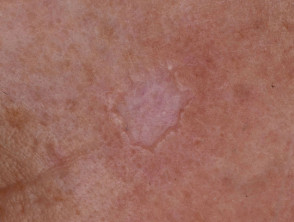
In patients with MSSE, the precursor SCC/KA lesions usually first manifest between the second and third decade of life. These eruptions can arise individually or in outbreaks, predominantly affecting sun-exposed skin areas or those subject to trauma. The initial lesion presents as a faint reddish macule that rapidly evolves over two to four weeks into a papule. It can reach diameters of 2 to 3 cm, stabilize for approximately two months, and finally invade, leaving a scar characteristic depressed scar.
An affected individual may develop up to one hundred of these lesions over time. It is relevant to note that family members may experience these lesions even if their history of sun exposure has been minimal, in contrast to the usual etiology of SCC and KA in the general population.
Images of SCC / KA Type Lesions in Familial Cases of Multiple Keratoacanthomas
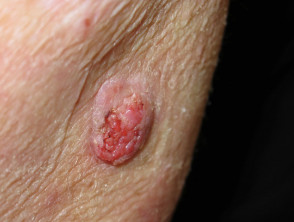
Manifestation of SCC / KA in Ferguson-Smith Disease
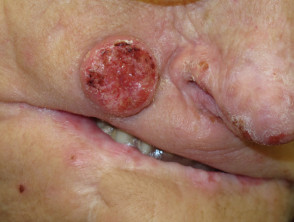
Example of familial multiple keratoacanthoma (Ferguson-Smith Disease)
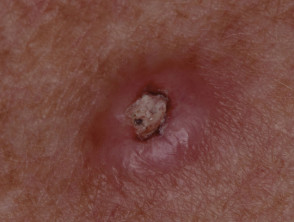
Skin lesion associated with Ferguson-Smith Disease
Early detection and dermatological follow-up are crucial for managing complications associated with Multiple Self-Healing Squamous Epitheliomas, given their hereditary nature and propensity for recurrence.
Understanding the Genetics of Familial Multiple Keratoacanthomatosis (MSSE)
Cases of Familial Multiple Keratoacanthomatosis (MSSE) have been documented in a wide geographic distribution, spanning Japan, the United States, and Denmark. This dispersion suggests that the actual prevalence of the disease might be higher than initially estimated. It is important to note that the clinical presentation varies; in some families, the phenotype manifests more mildly and the onset of the disease occurs later than in other affected lineages.
Initially, it was postulated that MSSE resulted from a single , originating from a founder mutation. While the disease is transmitted following an autosomal dominant pattern autosomal dominant (with a 50% chance of inheritance to offspring), its penetrance is not complete. There are reports of carriers obligate carriers who exhibit no clinical symptomatology whatsoever. Eleven distinct heterozygous substitutions mutations heterozygous mutations located in the Receptor 1 of the Growth Factor Beta of Transforming (TGFBR1), located on Chromosome Chromosome 9q22.
It is theorized that wild-type TGFBR1 operates as a tumor suppressor. Subsequent carcinogenesis would occur after a somatic deletion of the wild-type gene, following the classic second hit oncogenic mechanism.
Diagnostic Methods for MSSE
It is essential to suspect familial multiple keratoacanthomas in patients presenting with SCC/KA characteristic lesions at an early age and who also have a positive family history for the condition.
The characteristic histology histology of the familial type is distinguished from common keratoacanthoma (KA) because it lacks a prominent ‘shoulder,’ and leukocyte abscesses leukocyte abscesses.
The mucous membranes. The differential diagnosis for familial multiple keratoacanthomas must include the following conditions:
- Non-familial SCC and KA
- KAs associated with syndrome Muir-Torre syndrome
- Generalized eruptive generalized KAs of Grzybowski syndrome
- Xeroderma Pigmentosum
To confirm the diagnosis, blood samples or buccal swabs can be used to perform linkage studies and haplotype analysis, actively searching for mutations in the TGFBR1 gene located at 9q22. The presence of a heterozygous loss-of-function mutation in this gene is directly related to the susceptibility susceptibility.
In regions with high exposure to ultraviolet (UVUV) radiation predominance prevalence.
Treatment Options for MSSE
While individual SCC/KA-type lesions usually resolve without intervention, active treatment can accelerate healing and optimize the final cosmetic outcome. Most lesions are managed via surgical removal, whether by Excision, excision vascular laser or intense pulsed light is successful. If these options are unavailable, alternatives such as. , curettage, or
- Cryotherapy
- . Other treatments that have been reported include:
- Intralesional bleomycin
Although the radiotherapy Intralesional 5-fluorouracil development has been employed in cases of MSSE, it should be avoided if possible, as there is a risk of inducing the.
Corticosteroids development.
Oral retinoids, such as acitretin and isotretinoin, may be administered with the goal of decreasing the frequency and total number of tumors present.