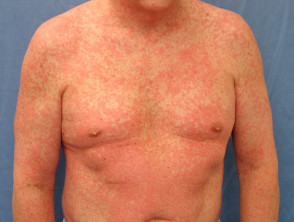
¿Qué es una Erupción Morbiliforme por Fármacos?
The erupción morbiliforme por fármacos represents the most frequent type of adverse drug skin reaction. While various drugs can trigger this allergic reaction, antibiotics are the most common culprit group. Clinically, this rash can mimic rashes caused by viral infections or bacterial infections. bacterial Unlike other.
- In an adult patient, a skin rash morbilliform rash usually originates from a medication.
- In the pediatric population, its cause is significantly more likely to be viral in origin.
This skin manifestation also receives other names, such as drug-induced maculopapular rash, maculopapular, drug-induced exanthematous rash, or exanthematous, or simply An exanthem or toxic erythema maculopapular rash.
Images of Morbilliform Drug Rashes
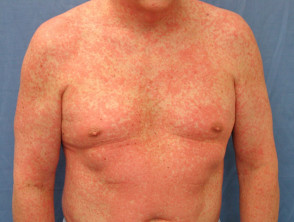
Lichenoid drug rash
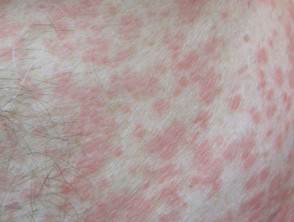
Lichenoid drug rash
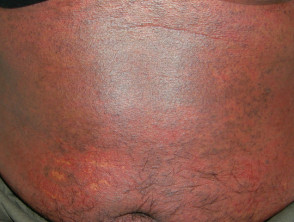
Morbilliform purpuric rash due to thrombocytopenia
¿Quiénes están en Riesgo de Desarrollar Erupción Morbiliforme por Fármacos?
Approximately 2% of all new medication prescriptions result in some form of drug-related rash. Of these cases, about 95% are rashes morbilliform pattern rashes.
The most affected population includes patients prescribed beta-lactam antibiotics (such as penicillins and cephalosporins), sulfonamides, allopurinol, antiepileptic drugs, and NSAIDs (nonsteroidal anti-inflammatory drugs). It is important to note that numerous other medicinal agents, including natural or herbal therapies, have also been associated with the appearance of morbilliform rashes.
There are several factors that can predispose to the development of this dermatological condition:
- Previous history of drug rashes or significant family history of adverse drug reactions.
- Presence of an Presence of an underlying viral illness, particularly Epstein-Barr Virus (EBV, the cause of infectious mononucleosis) or human herpes viruses 6 and 7 (associated with roseola or pityriasis pityriasis rosea).
- Immunodeficiency conditions, such as infection with the human immunodeficiency virus (HIV), fibrosis cystic malignancy are evaluated in patients with suspected connective tissue or autoimmune disease..
- Concomitant use of multiple medications (polypharmacy).
Factors and Characteristics of Morbilliform Drug Rash
A morbilliform rash arising as a reaction to a medication is a specific form of hypersensitivity. This condition involves a T-cell-mediated immune response by cytotoxic T cells, classified as a Type IV immune reaction. The trigger can be the administered drug, a metabolite generated from it, or a protein that has bound to the medication. This process triggers severe inflammation resulting from the release of cytokines and the participation of other effector immune cells.
Understanding the Causes of Drug-Induced Morbilliform Rash
Drug-induced morbilliform rash is classified as a hypersensitivity reaction specifically mediated by the action of cytotoxic T cells, constituting a Type IV immune response. The immune attack can be directed against the medication itself, against one of its metabolized molecules, or against a protein that has become bound to the drug. The subsequent inflammatory cascade is characterized by the release of cytokines and the mobilization of various immune cells to the affected area.
Distinctive Clinical Features of Morbilliform Drug Rash
The first time a patient experiences this reaction, the morbilliform rash generally manifests between one and two weeks after starting drug treatment; however, in rare cases, it may take up to one week after discontinuation. If the individual is re-exposed to the causative agent (or a related substance), the appearance of skin lesions accelerates notably, presenting within 1 to 3 days. It is extremely unusual for a medication taken continuously for many months or years to cause this type of rash.
Typically, the morbilliform rash begins on the trunk of the body and then progressively spreads to the neck and extremities. This distribution pattern is characterized by being bilateral and symmetric on both sides of the body.
The primary lesion defining this condition consists of a macule (spot) or papule (small bump) varying in color from pale pink to bright red.
- The morphology of the lesions can be varied, manifesting as annular (ring-shaped) lesions, targetoid (bull's-eye) appearance, similar to urticaria, or polymorphic.
- Generally, the lesions turn white when pressure is applied (blanchable), although this characteristic may be absent on the lower legs, presenting as purpuric (non-blanchable) lesions.
- Discrete or separate lesions have the capacity to merge, forming large erythematous (reddened) patches or plaques.
- Areas such as the armpits, groin, palms of the hands, and soles of the feet usually remain unaffected by the rash.
- A paradoxical manifestation involving prominence in the armpits and groin may be due to a Symmetrical Drug-Related Intertriginous Flexural Eruption (SDRIFE, by its English acronym).
- Mucous membranes, the scalp (hair), and nail structures are usually not affected in cases of uncomplicated drug rashes.
It is common for this rash to be accompanied by a low-grade fever and itching (pruritus). As the patient's condition improves, the redness dissipates, and a process of superficial skin peeling occurs.
Serious Complications Associated with Morbilliform Drug Rash
During the initial phase of presentation, it can be clinically difficult to differentiate an uncomplicated morbilliform rash from other significantly more severe Cutaneous Adverse Reactions (SCARs). These complications include:
- Drug Reaction with Eosinophilia and Systemic Symptoms (DRESS) Syndrome.
- Stevens-Johnson Syndrome (SJS) or Toxic Epidermal Necrolysis (TEN).
- Acute Generalized Exanthematous Pustulosis (AGEP).
It is crucial to closely monitor patients with morbilliform rashes to ensure early identification of any of these potential serious complications.
Patients presenting with the following signs or symptoms should be hospitalized for specialized evaluation and supportive care:
- Erythroderma Erythroderma (involvement covering the entire body)
- High fever or significant malaise associated with the condition
- Any involvement of the membranes
- Marked skin tenderness
- Blisters or erosions (Abrasions)
- Presence of pustules
- Palpable purpura o purpura
- Evidence of involvement of other vital organs (e.g., liver, kidneys, lungs, or hematological abnormalities)
Key Findings for Diagnosis of Morbilliform Drug Rash
The diagnosis of a morbilliform drug rash is based on a high clinical suspicion supported by two pillars:
- The clinical presentation of a typical exanthematous rash.
- The recent introduction of a new pharmacological agent.
To effectively identify the possible causative drug, drug, it is crucial to create a detailed timeline of medications. This record should include both prescribed and over-the-counter drugs. The start date of each new medication is documented in relation to the onset of the rash. This history should be reviewed backward, ideally for at least 2 weeks and up to one month.
Subsequently, medications are categorized as possible or unlikely causes based on criteria such as:
- Temporal correlation with the onset of the rash.
- Pharmacological data; certain medications can be ruled out if they rarely cause allergies. contact.
- Patient history regarding reactions to drugs in the same therapeutic class.
Currently, there are no standard laboratory tests to confirm the diagnosis or pinpoint the etiologic agent. The Differential Diagnosis Differential diagnosis erythema must consider conditions such as measles, rubella, scarlet fever, non-specific toxic diseases, erythema associated with infections, Kawasaki disease, connective tissue diseases, and graft-versus-host disease. host.
Generally, testing is not required if the causal agent is identified and discontinued, provided the rash is mild and the patient remains stable. However, the following evaluations may be requested:
- Routine blood tests, such as complete blood counts and determination of liver and kidney function, along with C-reactive Protein measurement).
- Serology C-reactive protein levels rashes to rule out infections presenting with.
- Possible biopsy similar rashes., infiltration perivascular Skin biopsy. Histopathological analysis frequently reveals interface dermatitis, histopathological features.
Peripheral blood eosinophilia mixed perivascular infiltrate, and other distinctive histopathological features. progression Eosinophilia is a supportive finding, but not diagnostic on its own. The need for further investigation will depend on the clinical course, the patient's progress, and the initial results obtained.
Therapeutic Approach for Morbilliform Drug Rash
The most crucial step in treatment is to identify and, if feasible, discontinue the implicated drug. In cases where the reaction is mild, but the medication is vital and non-substitutable, a specialist should be consulted to determine the safety of continuing administration before making a final decision.
- Close patient monitoring is recommended to detect any potential complications.
- It is beneficial to apply emollients along with creams emollients along with potent topical steroid creams.
- creams.
- In cases of intense skin erythema and edema, wet compresses can offer symptomatic relief.
Although antihistamines are frequently prescribed, their general utility in this type of exanthem is usually limited.
Prevention Strategies for Drug-Induced Morbilliform Rash
- It is impossible to completely eliminate the risk of developing morbilliform rashes. However, prescribing professionals must maintain high alert. The frequency of these events can be reduced through the following actions:.
- Restrict the prescription of antibiotics to the minimum when they are not strictly necessary.
- Thoroughly inform the patient about the etiology of their rash and warn them about the importance of avoiding re-exposure to the same medication.
Prominently record the adverse reaction in the patient's medical history for future alerts.
Prognosis: What to Expect from a Morbilliform Drug Rash?.
Once the causal drug is discontinued, the rash usually begins to show improvement within the following 48 hours, resolving completely within a period of 1 to 2 weeks.
- If medication exposure is maintained, the evolution of the rash may vary:.
- There may be spontaneous resolution despite continuous exposure to the drug. persist It could.
- persist without experiencing any change.