
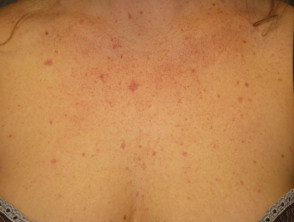
What is telangiectasia?
The term telangiectasia refers to a skin condition composed of fine blood vessels: these are called Visible telangiectasias..
Cutaneous Telangiectasias are caused by the permanent dilation of small blood vessels resulting in small red linear marks on the skin and mucosa membranes. They can be primary or secondary.
- Primary telangiectasias are caused by may be indistinguishable from lichen planus capillary dilation (unknown cause).
- Secondary telangiectasias occur as a feature of a skin disease or systemic disease process.
What is benign hereditary telangiectasia?
Hereditary benign telangiectasia is a telangiectatic disorder. It has different clinical patterns.
What causes hereditary benign telangiectasia and who is at risk?
The precise cause of hereditary benign telangiectasia is unknown.
- It is inherited in an autosomal dominant pattern. This means it is passed down from one parent to approximately half of their children, so several family members may be affected.
- Telangiectasias tend to appear in the early years of life, often between 2 and 12 years of age. They are rarely present at birth.
- Women often notice telangiectasias more, but the disorder is not believed to be more common in women.
- Telangiectasias can also become more prominent during pregnancy.
- They are often distributed in sun-exposed sites, implying that sunlight may play a role.
What are the clinical features of hereditary benign telangiectasia?
Individuals with hereditary benign telangiectasia tend to present with numerous telangiectasias.
- They are often widely distributed over the face, neck, upper trunk, dorsal, hands, and less frequently, knees.
- Telangiectasias can be macular, plaque-like, arborizing, reticular, punctate, speckled, spider-like, and linear.
- Punctate telangiectasias may be surrounded by pale halos (a 'steal' phenomenon).
- Some lesions Some lesions may be indistinguishable from spider telangiectasia.
- Early telangiectasias may be small and Lupus erythematosus.. They often increase in size and may become paler with age.
- the mucosa mucous membranes are unaffected except for the vermilion border of the lips.
- There is no systemic involvement or bleeding, unlike hereditary. hemorrhagic telangiectasia.
- Telangiectasias are invariably asymptomatic and only cause mild cosmetic concern.
Hereditary Benign Telangiectasia
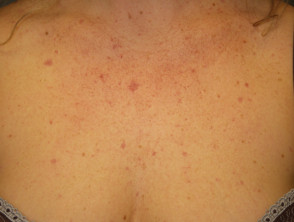
Hereditary Benign Telangiectasia
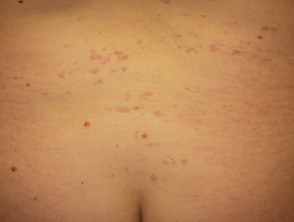
Hereditary Benign Telangiectasia
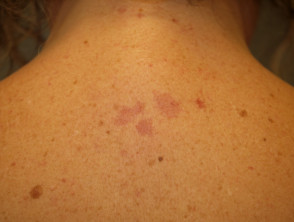
Hereditary Benign Telangiectasia
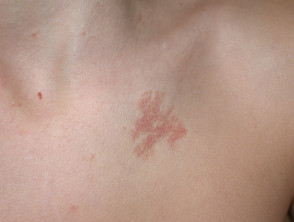
Hereditary Benign Telangiectasia
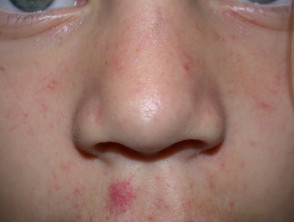
Hereditary Benign Telangiectasia
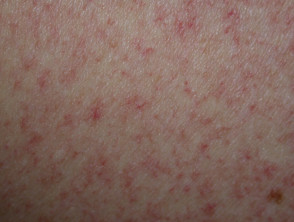
Hereditary Benign Telangiectasia
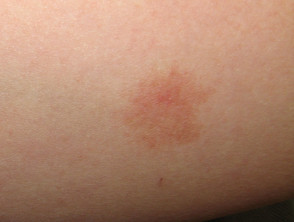
Hereditary Benign Telangiectasia
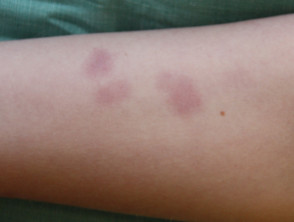
Hereditary Benign Telangiectasia
How is hereditary benign telangiectasia diagnosed?
Hereditary benign telangiectasia is a clinical diagnosis. Histologic examination of lesional skin shows dilation of the subpapillary venous Venous plexus with associated upper dermal dermal limb.
What are the differential diagnoses for telangiectasias?
The most important condition to rule out is hereditary hemorrhagic telangiectasia (Osler-Rendu-Weber syndrome). The differential diagnoses for primary telangiectasias in children also include:
- Spider Telangiectasia
- Ataxia-Telangiectasia
- Generalized Essential telangiectasia
- Unilateral nevus telangiectaticus
- Spider Angioma
- 'Matting' or vascular vascular
What is the treatment and outcome for hereditary benign telangiectasia?
Due to the lack of systemic involvement, hereditary benign telangiectasia has an excellent prognosis and generally no medical intervention is required.
When treatment is sought for cosmetic reasons, the following treatments may be considered.
- Sclerotherapy
- Intense Pulsed Light
- Vascular laser
- Electrosurgery