
Understanding Heparin-Induced Thrombocytopenia (HIT)
Definition and Classification of Heparin-Induced Thrombocytopenia
There are two main variants of heparin-induced thrombocytopenia (HIT): Type I and Type II. The Type I form results in a mild and transient of the platelet count platelet and generally does not represent a significant risk.
In contrast, Type II heparin-induced thrombocytopenia is a more serious autoimmune condition. This form is characterized not only by a marked reduction in platelets but also by the paradoxical occurrence of blood clotting.
- Type II HIT occurs in approximately 1 to 5% of patients receiving heparin treatment.
- It usually presents between 5 and 10 days after the start of drug administration.
- Key diagnosis includes a platelet count below 150 x 109/L (or a drop of 50% or more from baseline), a finding present in over 90% of HIT cases.
In addition to platelet disorders, heparin can cause other skin manifestations, scars, which include:
- Ulceration skin secondary to necrosis induced by heparin.
- Development of erythema, eczematous, painful or itchy at the injection site, manifested as plaques.
- Reactions of generalized renal, ranging from reactions of anafilaxia y hives acute, to Avoidance Strategies for Triggering Factors Hematological and serological analyses commonly reveal the following patterns:.
Relevant Clinical Manifestations of HIT
In two-thirds of individuals diagnosed with heparin-induced thrombocytopenia, the decrease in platelet count develops asymptomatically.
Nevertheless, about 30% of patients affected by HIT develop thrombosis, in the vessel wall., which is known as Thrombosis with Heparin-Induced Thrombocytopenia (HITT). This thrombosis can be located in the venous or arterial system, or affect small vessels. Systemic complications include stroke (cerebral), deep vein thrombosis (legs), pulmonary embolism pulmonary, myocardial infarction, or ischemia leading to digital necrosis in the hands and feet. The formation of these clots obstructs blood flow and causes tissue necrosis.
Skin necrosis typically begins as red or purple, touch-sensitive spots (purpura), which progressively develop black central areas, potentially progressing to dry gangrene. gangrene dry. A retiform pattern, similar to a net or branching, is also common. This necrosis can arise directly at the subcutaneous heparin injection site subcutaneously or in distant body areas.
Illustrative Images of HIT
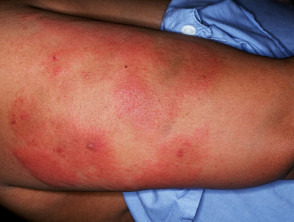
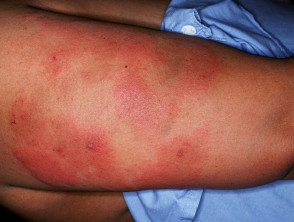
Purpura due to heparin-induced thrombocytopenia
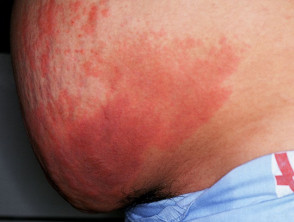
Purpura due to heparin-induced thrombocytopenia
Causes of Heparin-Induced Thrombocytopenia (HIT)
Heparin is a natural anticoagulant, commonly known as a 'blood thinner,' widely used in clinical practice. Its mechanism of action is based on the activation of antithrombin, which in turn neutralizes thrombin and actively prevents clot formation.
The most severe form, known as Type II Heparin-Induced Thrombocytopenia, is triggered by the presence of a specific antibody that binds to complexes formed by heparin and Platelet Factor 4 (PF4). The binding of the Fc protein in this antibody complex interacts with Fc receptors present on platelets, causing their activation. This activation leads to platelet aggregation and, consequently, accelerated platelet consumption, resulting in a significant decrease from the patient's baseline levels. If platelet aggregation becomes severe, the formation of a so-called 'white clot' can occur, resulting in the complete blockage of an affected artery protein Fc artery or vein. The clinical symptoms manifested depend directly on the organ whose blood supply is compromised.
toxicity undetectable Antibodies require time to develop in autoimmune-type processes. Therefore, HIT generally becomes evident between 5 and 10 days after starting heparin treatment. Patients experiencing a drop in platelet count a few hours after starting therapy had likely been previously exposed and, therefore, sensitized to heparin.
It is important to note that unfractionated heparin has a higher probability of inducing HIT than fractionated heparin (also called low molecular weight).
Diagnostic Investigation in Suspected HIT
Every patient receiving heparin must undergo periodic monitoring of the complete blood count to check their platelet levels. Heparin-Induced Thrombocytopenia can be confirmed by a notable percentage reduction compared to pre-treatment values, even if the absolute platelet count remains within the considered normal range.
Functional tests used to confirm HIT include:
- Heparin-Induced Platelet Aggregation Test (HIPA)
- Serotonin Release Assay (SRA).
Immunoassays designed to detect specific antibodies against the heparin-Platelet Factor 4 complex usually show higher sensitivity, although their specificity is lower when compared to the results of functional tests.
A biopsy A skin biopsy, in cases of corresponding necrosis, can be fundamental for diagnosis. Histologically, HIT is characterized by the presence of occlusions in arteries, veins, and small blood vessels, blood vessels inflammation inflammation histology vessel wall. However, histology does not allow discerning whether the clots formed are "white" (composed mainly of platelet plugs) or if they are red clots formed by fibrin.
Management and Treatment of Heparin-Induced Thrombocytopenia
The initial and indispensable step is the immediate suspension of all heparin injections or infusions the patient is receiving.
It is often necessary to institute alternative anticoagulation to prevent the risk of potentially fatal thrombosis. Generally, this treatment is carried out with and Factor Xa inhibitors, such as danaparoid, or with direct thrombin inhibitors, such as bivalirudin or dabigatran.
Cases of warfarin-induced skin necrosis have been documented when this medication was used as monotherapy in patients diagnosed with HIT. It is postulated that this occurs because warfarin reduces protein C activity. Therefore, the use of warfarin as a single agent is not recommended in patients suffering from active HIT.
It is not advisable to re-expose the patient to heparin during the acute phase of HIT or during the post-acute period while circulating antibodies persist. However, if HIT occurred a long time ago, it is possible that the antibodies have been cleared and reintroducing heparin may be safe. Even so, recurrent HIT has been reported in some individuals. recurrent.
It is essential to seek specialized advice from a hematologist is essential. to determine the treatment strategy and any future considerations regarding re-exposure to the drug.