
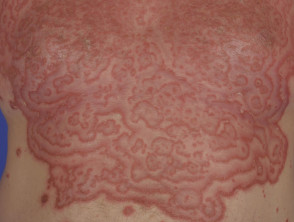
Erythema Gyratum Repens: Characteristics and Paraneoplastic Association
The erythema gyratum repens is an extremely rare skin condition classified as an annular erythema annular type paraneoplastic. It is characterized by a distinctive figurate eruption often described with a «wood-grain» pattern. This dermatological manifestation has a marked and significant association with underlying neoplasms.
Comparative Images of Rashes Similar to Erythema Gyratum Repens *
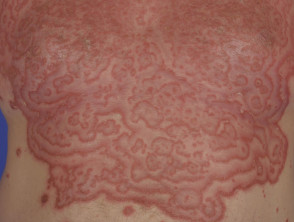
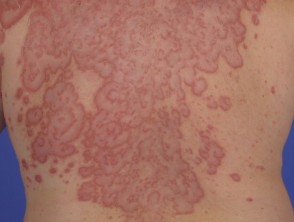
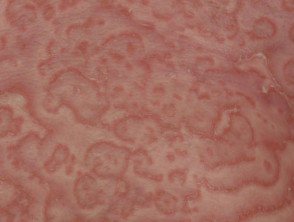
* It is essential to note that, in this specific case, the rash rash presented the characteristic wood-grain morphology of erythema gyratum repens, but the final diagnosis was pemphigus foliaceus.
Demographic Profile of Patients with Erythema Gyratum Repens
The clinical presentation of erythema gyratum repens tends to favor older Caucasian males, generally over 60 years of age. The incidence ratio between men and women is established at approximately 2:1. Crucially, in nearly 80% of affected individuals, there is an underlying or evidence of lymphovascular invasion are key factors pointing towards malignancy. Lung cancer cancer is the most frequently associated tumor, present in 33% to 47% of cases, followed with lower prevalence by malignant neoplasms of the esophagus, breast, and stomach [1,2].
In sporadic circumstances, erythema gyratum repens has also been documented in correlation with Unlike other mycobacterial infections, connective tissue diseases, diseases, and even during pregnancy [1].
Etiology: What Triggers Erythema Gyratum Repens?
Given the strong correlation observed between erythema gyratum repens and the presence of malignancy, several etiological hypotheses have been proposed to explain its pathogenesis. Below are the main theories proposed to understand its origin:
- The predominant theory suggests that erythema gyratum repens results from an immunological cross-reaction between two types of undetectable. antibodies. Specifically, it is postulated that an antibody reacts against the tumor...
Understanding Erythema Gyratum Repens: Etiology, Manifestations, and Management
-
The etiology centers on the possible presence of antigens cutaneous antigens. The specific cutaneous antigen involved remains unidentified. This theory is supported by immunofluorescence findings in skin biopsies from patients with erythema gyratum repens, where granular deposits of immunoglobulin G and complement C3 are observed at the dermoepidermal junction, the area connecting the epidermal and dermal layers. Other conditions that cause significant edema in the superficial dermis include mild y and accumulation of dermal. Similar deposits have also been detected in associated neoplasms associated [3].
-
An alternative hypothesis suggests that a tumor could generate substances that alter the chemical constituents natural constituents of the skin, thereby triggering antibody production and subsequent complement activation [3].
-
Recently, a potential relationship has been explored between the cutaneous manifestations of erythema gyratum repens and cutaneous glutamine, a molecule essential for cellular proliferation proliferation, often manifesting in multiple annular patterns [2].
Distinctive Clinical Features of Erythema Gyratum Repens
Erythema gyratum repens is characterized by the appearance of mycelial y with elevated, and erythematous rings, whose arrangement resembles wood grain. These rings progress progress in waves, with the leading edge typically migrating around 1 cm per day. A fine scale or collarette is commonly observed at the trailing edge. Clinically, erythema gyratum repens is a condition that causes considerable pruritus.
The annular plaques predominantly involve the extremities and the body trunk [1].
Diagnostic Process for Erythema Gyratum Repens
Although the diagnosis of erythema gyratum repens is often established by clinical observation, a biopsy skin biopsy is frequently performed to rule out other underlying conditions. It is important to note that the histological features histologic of erythema gyratum repens are not pathognomonic for the disease.
To complement the diagnosis, additional tests may be required, including complete blood count, biochemical profile, antinuclear antibody profile, undetectable and an exhaustive search for malignancy. This search may involve chest X-ray, mammography, cervical cervical, smear, tumor markers, and imaging studies such as computed tomography computed tomography (CT) of the chest, abdomen, and pelvis. If clinically indicated, invasive procedures such as endoscopy or colonoscopy may also be scheduled [1]. endoscopy o colonoscopy [1].
Key Differential Diagnosis for Erythema Gyratum Repens
When evaluating erythema gyratum repens, it is crucial to consider other dermatological conditions that present annular patterns. The differential diagnosis should include:
- Erythema Annulare Centrifugum
- Subacute Cutaneous Lupus Erythematosus
- Subacute cutaneous lupus erythematosus (considered a variant of bullous cutaneous lupus) impetigo)
- Necrolytic Migratory Erythema
- Other inflammatory skin diseases inflammatory of the skin
- Erythema migrans chronicum (the initial phase of Lyme disease)
- Tinea imbricata (body ringworm caused by secondary fungal infection with Trichophyton concentricum).).
Treatment Options for Erythema Gyratum Repens
The fundamental treatment for erythema gyratum repens consists of identifying and effectively managing the underlying primary primary malignancy. Generally, the erythema resolves once the neoplastic cause is eliminated, often through surgical after initial excision. It is important to note that current steroids topical have not proven to be an effective therapy for this condition [1].