«`html
Understanding Drug-Induced Follicular Eruptions
What Are Follicular Eruptions?
Follicular eruptions are skin conditions that originate directly in the follicle hair follicle (or hair follicle). hairWhen these eruptions are triggered by the administration of drugs, they can manifest acutely or chronically. acute o chronic.
Clinically, they are characterized by the appearance of A higher prevalence of a reticular (or mesh) pattern is observed, which primarily corresponds to the junctional component. erythematous follicular papules and sometimes, pustules., pustules.
These drug-induced skin manifestations receive various names, including papulopustular acneiform eruptions acneiform Papulopustular eruptions, drug-induced folliculitis, and drug-induced acne.
Who Is Susceptible to Developing Drug-Induced Follicular Eruptions?
Follicular eruptions are considered relatively uncommon, accounting for only about 1% of cutaneous adverse drug reactions. scars The probability of developing them increases considerably with certain types of drugs and in populations predisposed to acne, such as adolescents. There is a tendency to affect men more frequently than women.
The differential diagnosis of drug-induced follicular eruptions is simpler in age groups that do not typically present with acne vulgaris, since the latter is a much more prevalent disorder, prevalent, which often leads to drug-induced acne not being initially considered in the evaluation.
It is essential to note that the risk of developing an eruption or develop a rash of this type is directly related to the administered dose and the total duration of drug treatment.
What Drugs Trigger Follicular Eruptions?
The main classes of medications (along with common examples within those categories) known to cause follicular eruptions include:
- Antibiotics: Especially isoniazid, rifampin, and tetracyclines.
- Steroids: Such as adrenocorticotropic hormone (ACTH), androgens, and systemic corticosteroids. androgens malignant acanthosis nigricans corticosteroids steroids.
- Hormones: Mainly oral contraceptives.
- Halogens: Compounds such as iodides and bromides.
- Immunosuppressants: Including azathioprine, cyclosporine, and sirolimus.
- Lithium.
- Lithium..
- Inhibitors of the epidermal of the receptor of the and insulin-like epidermal Anticonvulsants.
- Epidermal growth factor receptor inhibitors (EGFRIs).
Vitamins: Specifically vitamins B1, B6, and B12 in high doses.
Mechanisms Involved in Drug-Induced Folliculitis
- Various hypotheses have been formulated to explain the pathways through which certain drugs induce folliculitis: nodes sebaceous.
- Steroids have historically been linked to the appearance of drug-induced acne due to their marked influence on sebaceous gland activity. nuclear Although lithium does not appear to show a clear dose-dependent relationship.
with follicular eruptions, the presence of high concentrations of retained lithium in the skin has been documented, suggesting a potential local accumulation effect.
```
- It is vital that patients inform their dermatologist about all medications they are taking if they experience unexplained outbreaks. Early identification of the causal agent is crucial to stop the progression of the adverse reaction and restore skin health.
- Sirolimus may cause acne by inhibiting epidermal growth factor (EGF). epidermis, , sebaceous glands malignant acanthosis nigricans follicles Although the exact mechanism by which epidermal growth factor receptor (EGFR) inhibitors cause follicular eruptions is not fully elucidated, there are operational EGFR receptors in the epidermis, sebaceous glands, and hair follicles, keratinocytes. , as well as in keratinocytes. It is postulated that the effect of EGFRIs on keratinocytes may trigger apoptosis, apoptosis vesicles y pustules.
, which consequently leads to the formation of vesicles and pustules.
Clinical Characteristics of Drug-Induced Follicular Eruptions.
- The timing of the appearance of follicular eruptions is intrinsically linked to the pharmacological agent involved.
- Acute eruptions generally manifest within the first two weeks of starting treatment.
- Papules and pustules tend to arise rapidly, within a span of days to weeks, especially with the use of steroids, halogens, and EGFRIs.
Conversely, chronic forms may take months or even years to appear, as is the case with drugs like lithium or certain anticonvulsants.
- The distinctive manifestations of drug-induced folliculitis usually include:.
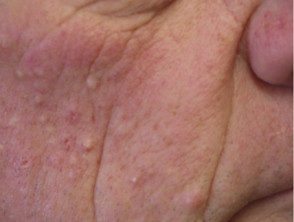
- The presence of clusters of erythematous papules and pustules with similar morphology among them.
- Predominant location on the trunk, shoulders, arms, and face. comedones.
Drug-Induced Follicular Eruptions
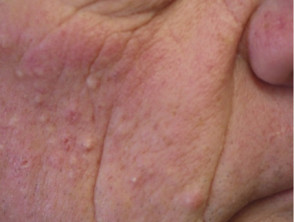
Unlike acne vulgaris, there is a noticeable absence of comedones.
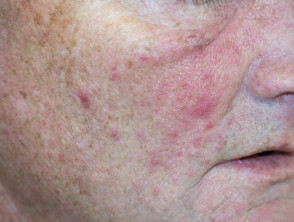
Vemurafenib folliculitis
Sirolimus folliculitis
Diagnosis of Drug-Induced Folliculitis biopsy Generally, the diagnosis of a drug-related follicular eruption is established through clinical evaluation and a detailed history confirming exposure to a known causal agent. It is relevant to consider measuring the levels of the suspected drug when feasible (e.g., in lithium therapies). If a skin biopsy is performed, histological analysis histological can show the following characteristics:
- Increase in the size of the hair follicles (dilation).
- Erosion of the infundibular epithelium. of the epithelium infundibular.
- Presence of aggregates of
- Presence of aggregates of neutrophils.
- An infiltrate neutrophils. perifollicular, A perifollicular lymphoneutrophilic infiltrate , which includes foreign body giant cells. and foreign body giant cells.
Bacterial culture is generally not necessary and is negative. Microscopy bacterial occasionally identifies Malassezia species yeasts, microscopy especially when corticosteroids are the cause of the eruption (steroid acne). Malassezia, Differential Diagnosis of Follicular Eruptions.
Differential Diagnosis It is essential to consider other diagnoses in patients presenting with follicular-type eruptions, including:
Acne vulgaris.
- Acne vulgaris.
- Folliculitis caused by infection secondary (whether bacterial, viral, or fungal) or by environmental irritants. irritants Likewise, drug-induced folliculitis may become complicated by an underlying infection, a scenario particularly common in folliculitis caused by EGFRI inhibitors.
Treatment for Drug-Induced Follicular Eruptions.
The initial and most crucial step in treatment should be discontinuing the causative medication, whenever feasible. Currently, scientific evidence supporting the optimal treatment for persistent follicular eruptions in patients required to maintain administration of the causative drugs
is not conclusive and remains an active area of research. persistent. It commonly affects smokers and is considered pre For mild folliculitis, topical treatments commonly used against acne may be effective: Benzoyl peroxide. Combinations with Clindamycin or Erythromycin.
Application of retinoids, such as topical tretinoin.
- In cases requiring more serious intervention, systemic therapy may include:.
- An antibiotic from the tetracycline family, such as Doxycycline or Minocycline.
- Application of Topical, Isotretinoin administered orally.
Prognosis of Drug-Caused Follicular Eruptions
- The vast majority of drug-induced follicular eruption cases show spontaneous resolution within a few weeks after discontinuing the etiologic agent. If the eruptions become persistent or do not improve, it is imperative to seek expert evaluation from a dermatologist.
- to adjust management.
vemurafenib-folliculitis__protectwyjqcm90zwn0il0_focusfillwzi5ncwymjisinkilduzxq-7325942-5130703-jpg-7846306
«`html Understanding Drug-Induced Follicular Eruptions What Are Follicular Eruptions? Follicular eruptions are skin conditions that originate directly in the hair follicle (or hair follicle). When these eruptions are triggered by the administration of drugs, they can manifest acutely or chronically. Clinically, they are characterized by the appearance of [...] dermatologist para ajustar el manejo.