
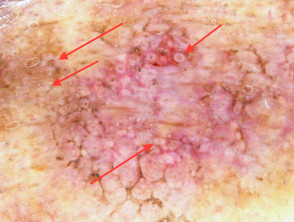
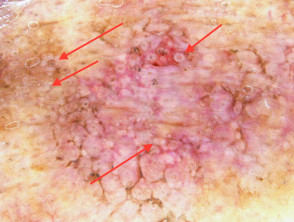
Identification and Appearance of Concentric Circles in Dermoscopy
toxicity concentric circles represent a specific dermoscopic sign, frequently associated with melanoma, particularly in the subtype known as lentigo maligna facial. However, this feature has low diagnostic sensitivity, as its presence is uncommon. In a study by Tschandl et al., these circular patterns were only identified in 4.2% of flat facial lesions diagnosed as melanomas, which tend to be lesions larger lesions [1]. Alternatively, concentric circles are known as the «circle within a circle» sign or the isobars sign.
How Do Concentric Circles Look Under the Dermatoscope?
From a technical perspective, concentric circles manifest as a pigmented and symmetrical follicular opening, pigmented skin y symmetrical, surrounded by a dot that is darker and located just inside the ostial openings. This specific arrangement is key to their accurate identification during the dermoscopic examination. asymptomatic.
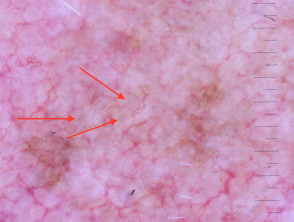
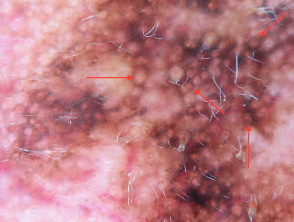
It is essential to remember that while concentric circles are a diagnostic clue, especially in nonspecific facial lesions, their low prevalence requires specialists to consider the general clinical context and other dermal indicators to establish an accurate diagnosis of melanoma or precursor lesions.
Concentric Circle Patterns in Dermoscopy: A Key Indicator
Straight lines that meet at angles greater than 90 degrees, without crossing other patterns, and that form complete or partial polygonal shapes, are known as angular lines or angular patterns. In the context of dermoscopy, the presence of concentric circles constitutes a diagnostic signal of great value, especially when melanoma is suspected. Although it is a prominent finding in malignant lesions, this pattern can occasionally be observed, although rarely, in pigmented actinic keratosis (pBCC).
Lesions Associated with Dermoscopic Concentric Circles
The presence of concentric circles visible through the dermatoscope mainly suggests the following conditions:
- Lentigo maligna.
- Pigmented actinic keratosis (actinic seborrheic keratosis) (infrequent manifestation).
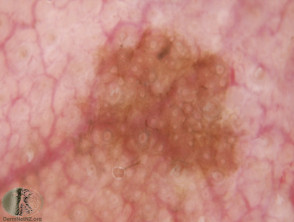
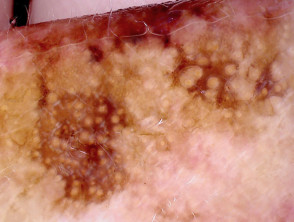
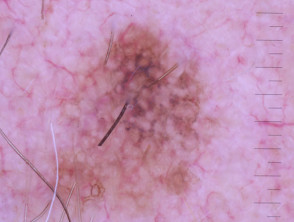
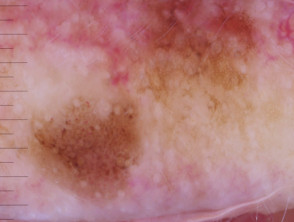
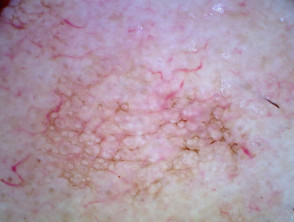
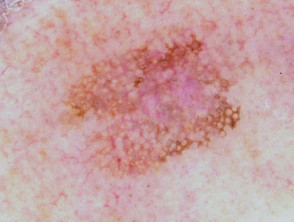
The precise identification of these dermoscopic patterns is fundamental for the differential diagnosis between benign lesions and melanomas. The constant presence of concentric circles in the study of the lesion should guide the dermatologist toward an exhaustive evaluation of lentigo maligna.