
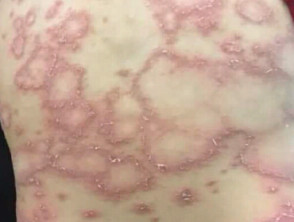
¿Qué es el Eritema Anular Centrífugo?
Erythema annulare centrifugum (EAC) constitutes a reactive form and chronic of annular erythema. annular. It is characterized by the appearance of Lupus erythematosus. erythematous lesions that take circular forms, arcuate y annular or polycyclic plaques,. A distinctive feature is the presence of a fine The presence of a superficial scale that is left behind, located just behind the leading edge of the lesion, a phenomenon known as ‘trailing scale’.
Clinical Images of Erythema Annulare Centrifugum
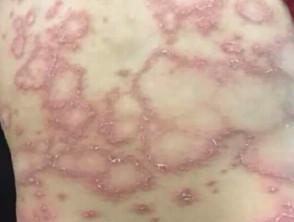
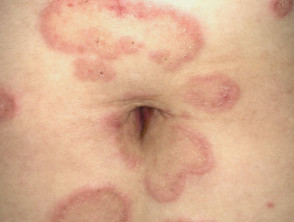
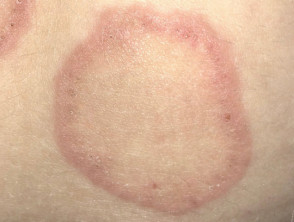
Explore a visual gallery to observe more examples of the lesions characteristic lesions of erythema annulare centrifugum.
Affected Population and Epidemiology
Although erythema annulare centrifugum can manifest in any age group, its incidence is higher in the adult population. Generally, the average age at which this condition is diagnosed is around 40 years [1].
Possible Causes of Erythema Annulare Centrifugum
In a significant percentage of cases, between 33% and 72%, erythema annulare centrifugum presents simultaneously with other underlying diseases or as a reaction to medication intake [1,2]. It is postulated that this condition represents a manifestation of a hypersensitivity response. renal.
Among the medical conditions most frequently associated with EAC are:
- Cutaneous secondary fungal skin infection (especially tinea pedis).
- Diagnosis of anemia or evidence of lymphovascular invasion are key factors pointing towards internal malignancy.
- Severe to drugs.
- Pregnancy or Gestation period.
- Benign cellular hematologic.
- Endocrine effects.
- Rheumatic conditions.
Additionally, associated dietary factors have been identified, such as the consumption of blue cheese and tomatoes. Emotional stress has also been reported as a potential trigger for the disease [1,3].
Clinical Presentation: Where Do the Lesions Appear?
Clinically, erythema annulare centrifugum usually localizes preferentially on the lower extremities (thighs), the gluteal region, and the upper arms. However, it is important to note that the symptoms can manifest in any area of the body integument.
Erythema...
Erythema annulare centrifugum typically begins as a small papule erythematous papule that progressively grows over several weeks, transforming into a ring or plaque plaque with a clear center. These annular lesions vary in diameter, from a few millimeters to several centimeters. The plaques may manifest incompletely (in the shape of an arc or arcuate) and, upon fusion, can generate polycyclic (ringed), serpiginous (wavy) or gyrating (spinning) patterns.
Classically, the annular or arcuate lesions exhibit an expanding erythematous outer border, followed by a posterior inner border that is usually scaly. This rash skin eruption may be accompanied by itching.
Diagnosis of Erythema Annulare Centrifugum
On occasion, erythema annulare centrifugum can be diagnosed based solely on clinical features, especially if the characteristic scale trailing the lesion edge is present. Diagnosis can also be confirmed by a skin biopsy biopsy, where distinctive histopathological patterns of superficial or deep EAC are observed: a dense lymphocytic perivascular infiltrate that affects the perivascular lymphocytic infiltrate infiltrate vascular plexus superficial or deep, known as the "cuffing" pattern. Secondary changes in the epidermis epidermis spongiosis spongiosis inflammation characterized by edema intercellular), parakeratosis parakeratosis keratinization, and hyperkeratosis hyperkeratosis.
The search for an underlying cause should be guided by the patient's clinical history and physical examination findings. It is essential to perform cancer screening cancer symptoms profile symptoms .
If fungal infections such as onychomycosis, tinea pedis (athlete's foot), or tinea corporis are suspected, skin scrapings and nail clippings should be taken for mycological analysis.
Considerations in the Differential Diagnosis of Erythema Annulare Centrifugum
When evaluating a case of erythema annulare centrifugum, it is crucial to consider several skin conditions that may present clinical similarities. The differential diagnosis should include other variants of annular erythema, such as:
- Persistent erythema: A rash skin eruption of . paraneoplastic nature linked to an underlying malignancy, characterized by concentric rings concentric and gyrating patterns.
- Erythema gyratum repens: Also a paraneoplastic eruption, recognized by its "wood-grain" appearance, which manifests as rapidly progressing erythematous lines arranged in a concentric pattern.
- Necrolytic migratory erythema: This presents rashes annular, crusts lesions of red color that progressively develop blisters, erosions, and finally, crusts over time. Classically, this manifestation is associated with an underlying glucagonoma (a glucagon-producing tumor).
Considering these conditions helps refine the diagnosis and ensure appropriate treatment for erythema annulare centrifugum.
- Insulinoma Insulinoma (a tumor that develops in the islets of Langerhans).
- Erythema annulare: a skin eruption associated with fever rheumatic fever acute; acute rheumatic fever macules ; characteristically it presents as pink or red macules, or papules, papules.
- , which expand externally in a circular fashion with a well-defined border. In cases of suspected drug or food allergy as a cause of acute hives, skin prick tests or RAST (radioallergosorbent test) or CAP fluoroimmunoassay tests may be ordered to confirm specific sensitization. Erythema multiforme: targetoid-appearing lesions demarcated, that appear on the back of the hands and the tops of the feet (although they can arise anywhere); they consist of abruptly demarcated, pinkish-red macules that gradually grow to form plaques; the central area of the lesions changes color or clears, generating an annular morphology.
- Migratory erythema (early stage of Lyme disease): an expanding reddish patch on the skin that originates at the site of a tick bite and progressively enlarges, potentially reaching several tens of centimeters. patch Other important differential diagnoses to consider include:.
Tinea (dermatophytosis): scaly annular lesions, with gradual growth and itching, presenting central clearing.
- Granuloma.
- Granuloma annulare: an annular eruption characterized by a rubbery, raised, erythematous border, with central clearing.
- Erythema papulatum centrifugum: an itchy condition related to sweating, where erythematous papules form expanding annular and arcuate structures on the trunk and extremities.
- Secondary syphilis: can manifest with polycyclic, non-pruritic scaly annular plaques.
- Cutaneous lupus erythematosus, specifically subacute cutaneous lupus erythematosus and systemic lupus systemic.
erythematosus. eczema Scaly annular plaques are also frequent manifestations in discoid, , nail psoriasis eczema, chronic plaque psoriasis, seborrheic dermatitis, dermatitis Fulminant rosacea., , pityriasis pityriasis rosea, porokeratosis, and sarcoidosis.
Treatment for Erythema Annulare Centrifugum
It is crucial to identify and address the underlying etiology of erythema annulare centrifugum whenever practicable, as is the case with a superficial fungal infection.
Topical Therapy Options
Topical treatments that have been used to manage erythema annulare centrifugum include:
- Corticosteroids of topical Topical corticosteroids.
- Inhibitors of the epidermal Topical calcineurin inhibitors (such as tacrolimus and pimecrolimus).
Systemic Therapy Treatment
Systemic drugs used to treat the root cause of erythema annulare centrifugum include:
- Fluconazole [4]
- Azithromycin [5]
- Erythromycin [6]
- Metronidazole [7].
Etanercept [8] has been reported to induce remission remission widespread.
in a patient with erythema annulare centrifugum
extended. recurrence Prognosis of Erythema Annulare Centrifugum remission Erythema annulare centrifugum has a tendency to persistent. It commonly affects smokers and is considered pre recurrence.