Nomenclature and Definition of Erythema Annulare
Erythema annulare is a descriptive classification that encompasses a variety of skin manifestations Malignancy., annular, and erythematous. Various terms are used to name these lesions skin infections, such as:
- Annular Erythema
- Erythema Annulare Centrifugum
- Figurate Erythema
- Persistent Erythema
- Erythema gyratum perstans
- Erythema figuratum perstans.
Although often related, erythema gyratum repens is generally treated as a separate diagnostic entity.
Clinical Manifestations of Erythema Annulare
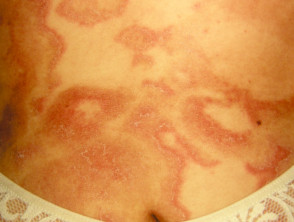
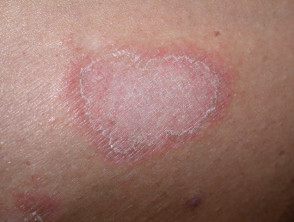
Explore a more extensive collection of images on erythema annulare manifestations.
Identification of Characteristic Signs and Symptoms of Erythema Annulare
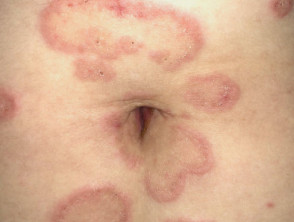
Erythema annulare can manifest at any age, from childhood to old age. Typically, the rash rash begins as a small, raised, pinkish-red macule that progresses slowly, expanding to form an annular pattern. As this occurs, the central area tends to flatten and fade. It is common to observe a peripheral border with some degree of scaling. desquamation.
The rings grow at an approximate rate of 2 to 5 mm per day until they reach a final diameter of almost 6 to 8 cm. In some cases, the lesions do not develop complete rings, adopting more irregular shapes. A single extensive lesion or multiple simultaneous eruptions may be present.
Erythema annulare is most frequently located in the thigh and leg area; however, it can spread to the trunk, arms, and even the face. Generally, these skin lesions are asymptomatic, although a subset of patients reports mild sensations of itching or burning.
Potential Causes of Erythema Annulare
Frequently, the precise etiology of erythema annulare remains undetermined. However, dermatology has documented that this ring-like eruption pattern is sometimes associated with underlying pathologies and conditions. These associated causes include:
- Infections of hereditary bacterial, fungal, and viral infections, such as tuberculosis or secondary syphilis.
- , it may reduce medication requirements and thus the side effects of those medications. ,, candidiasis, or ringworm.
- Medications including chloroquine and hydroxychloroquine, estrogen, penicillin, and amitriptyline.
- Foods, commonly blue cheese or tomatoes.
- Appendicitis recurrent or chronic.
- Disease Cholestatic liver disease (obstruction of the biliary system).
- Graves' disease (when the salivary thyroid is overactive).
In these circumstances, erythema annulare resolves once the underlying causal agent or the causative drug is addressed or discontinued. causative drug.
Diagnosis Process for Erythema Annulare
The diagnosis of erythema annulare is established clinically and can be confirmed by histopathology. This analysis will reveal a infiltration lymphocytic perivascular.
Additional tests may be required to rule out other conditions that cause rashes annular rashes and to identify any underlying disease.
The mucous membranes. The differential diagnosis of erythema annulare includes the following conditions:
- Erythema gyratum perstans, a rash . linked to an or evidence of lymphovascular invasion are key factors pointing towards underlying condition, characterized by whirling, concentric rings. concentric.
- Erythema migrans (associated with Lyme disease).
- Targetoid lesions seen in erythema multiforme.
- Plates Annular plaques with central blisters in fixed drug eruption and bullous pemphigoid. bullous.
- Serpiginous plaques in cutaneous cutaneous larva migrans.
- Annular plaques dermal in the granuloma annulare and in a variant of lichen planus.
- Annular plaques cells in the eczema nummular, chronic plaque psoriasis, plaques, , dermatitis Fulminant rosacea., , pityriasis rosacea, discoid lupus, porokeratosis, and tinea (a secondary dermatophyte infection).
- Smooth and urticarial annular lesions hives, Sweet's syndrome of Sweet's syndrome, mild polymorphic eruption, lesions are observed, characterized by epidermal subacute cutaneous lupus erythematosus, and systemic lupus erythematosus. systemic.
Treatment Options for Erythema Annulare
Erythema annulare frequently resolves spontaneously. The skin eruptions can persist from a few weeks to several years (with an average duration of 11 months). Most cases of erythema annulare do not require specific therapeutic intervention, as a definitive curative treatment is unknown. However, current application of corticosteroids topical of corticosteroids can be beneficial in reducing redness, inflammation, and associated itching.