Telogen Effluvium: Understanding the Causes and Crucial Distinctions
Definition of Telogen Effluvium
Telogen effluvium is a common cause of hair loss that occurs when a significant amount of hair in the resting phase (telogen) sheds prematurely. This phenomenon happens as a direct reaction to considerable bodily stress or alteration. It is essential to understand that, under this condition, the hair follicle does not cease its activity but continues to generate new hair. The hair in this resting phase is called a club hair due to the characteristic morphology of its root.
It is crucial to differentiate this condition from anagen effluvium, where hair loss occurs due to the abrupt interruption of the active growth phase (anagen). This interruption can be caused by toxins, certain medications, or intense inflammatory processes, such as those observed in alopecia areata. Unlike telogen hair, anagen hair is identified by having a more conical or pointed tip.
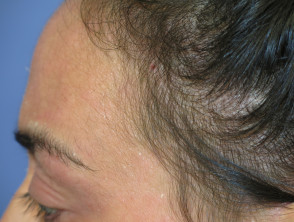
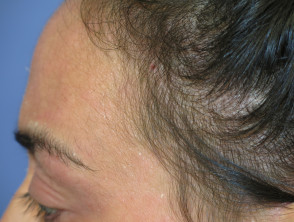
Visualization of Telogen Effluvium
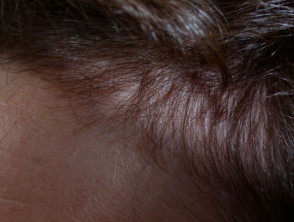
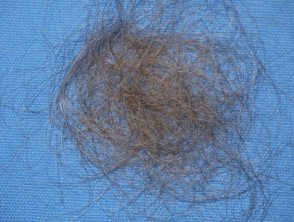
Who Does Telogen Effluvium Primarily Affect?
Acute telogen effluvium can manifest in people of any age and gender, usually being reactive. However, the chronic form of this condition, especially when the triggering cause is not easily identified, is observed with greater prevalence in adult women, typically in the age range between 30 and 60 years.
Understanding the Etiology Behind Telogen Effluvium
A healthy scalp maintains a seasonal balance in its hair follicles: approximately 85% are in the active growth phase (anagen), while about 15% remain in a resting state (telogen). A very small percentage of follicles go through the regression phase (catagen).
Generally, each individual follicle completes a prolonged anagen cycle of about four years, followed by a resting phase that lasts approximately four months. During this latency period, a new anagen hair begins to form just beneath the inactive hair, gradually forcing it out.
Due to this natural and constant biological cycle, it is completely normal to experience the daily loss of up to about 100 hairs, residue found in the comb, brush, drain, or pillow. Only when a stressful event causes a larger number of follicles to simultaneously enter the telogen phase does telogen effluvium occur.
If you experience alarming hair loss that exceeds this normal number and persists over time, it is essential to initiate a medical evaluation to determine the triggering factor and begin the appropriate treatment.
Triggers and Clinical Characteristics of Telogen Effluvium
If a significant alteration forces a large number of hair follicles to prematurely transition to the telogen (resting) phase, the condition known as telogen effluvium begins.
The impact on the system can be so drastic that up to 70% of hair in the anagen phase (active growth) can be precipitated (accelerated) into the telogen phase. This reversal significantly alters the normal proportion of follicles in each stage of the hair cycle. The most common triggers causing this massive shedding include:
- Childbirth: Triggers the manifestation known as postpartum hair loss. This scenario generally resolves spontaneously in a few months, although in some cases it may progress to female pattern alopecia.
- Hair loss Systematic y physiological.
- Acute or chronic conditions, especially those accompanied by fever high fever.
- Major surgery procedures.
- Severe trauma or significant accidents.
- Episodes of intense emotional stress.
- Rapid weight loss, extremely restrictive diets, or key nutritional deficiencies, such as iron deficiency.
- The administration or discontinuation of certain medications.
- Endocrine effects, such as hypothyroidism or the hyperthyroidism.
- Stopping the use of oral contraceptives.
- Severe time zone changes (jet lag) after international travel.
- Dermatological conditions that directly impact the scalp (e.g.: erythroderma).
- Excessive unprotected sun exposure.
Clinical Characteristics of Acute Telogen Effluvium
Telogen effluvium is distinguished by diffuse hair loss non-scarring alopecia (present in 50% of cases)., without presenting clinical manifestations or evidence histological of underlying inflammation. This reactive process can cause the loss of up to 50% of the existing hair on the scalp.
Initially, hairs already in their resting phase (known as club hairs) maintain good follicular adhesion. However, new hair beginning its growth cycle actively pushes these mature hairs toward the surface. For this reason, the noticeable increase in the amount of lost hair typically manifests between two and four months after the triggering stressful event.
Counterintuitively, in this form of alopecia, follicular loss is an indicator that the growth phase of new hair is reactivating correctly.
- When new hair visibly emerges on the scalp, pushing out the inactive hair, it is common to see a subtle line of newly emerging hair along the frontal contour.
- Although the initial shedding can be intense and suggest generalized thinning, this loss reaches its peak and then begins to decrease progressively, usually stabilizing within a range of 6 to 9 months in most patients.
- As the shedding rate decreases, hair density on the scalp is restored. However, it is important to note that in certain circumstances, full density recovery may not be achieved.
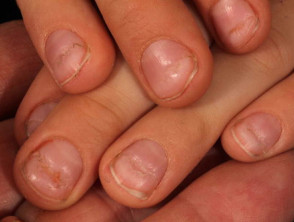
Since the growth cycles of hair and and nail are governed by the same systemic influences, any significant arrest or alteration in the hair cycle is usually also reflected in the and nail. This manifests through transverse grooves that chronologically coincide with the time of the systemic impact, called Beau's lines (or grooves). It is possible to estimate the date of the disruptive event, as a nail requires approximately five months to grow from the posterior nail fold to its free edge. For example, if the groove is observed exactly in the middle of the nail plate, it is deduced that the bothersome event occurred about two and a half months ago. Beau's. It is feasible to estimate the date of the disruptive event, as a nail requires approximately five months to grow from the fold of the nail to reach its free edge. For example, if the groove is observed exactly in the middle of the nail plate, it is deduced that the bothersome event occurred about two and a half months ago.
Beau's Lines on Nails
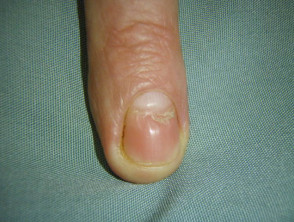
Example of Beau's line 02
Understanding the chronology of acute telogen effluvium is crucial for diagnosis, as the manifestation of hair loss is always delayed relative to the causal agent. If you experience sudden and abundant hair loss, it is essential to consult a dermatologist to identify and manage the triggering factor and ensure optimal hair recovery.
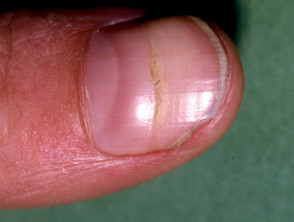
Understanding acute telogen effluvium is fundamental for diagnosing the underlying cause, since the resolution of hair loss depends directly on the elimination or management of the initial triggering factor. After the period of stress or shock has passed, the hair generally restores its normal growth cycle.
Chronic Telogen Effluvium: A Persistent State of Hair Loss
In certain patients, hair loss remains intermittently or continuously higher than the normal threshold for long periods, sometimes extending for years. This pattern is associated with an alteration in the dynamics of the hair cycle, where the anagen phase (active growth) appears to shorten notably.
Chronic telogen effluvium is more prevalent in women who, despite constant shedding, still maintain relatively good hair density and length. These patients notice the loss more evidently compared to those who already have fine or sparse hair. It is crucial to emphasize that telogen effluvium by itself does not lead to total baldness. However, it can make an underlying genetic predisposition more apparent: female androgenetic alopecia or male androgenetic alopecia.
The exact mechanism driving chronic telogen effluvium is still not completely understood. In middle-aged women experiencing a prolonged and fluctuating course of this condition, resulting in extensive hair thinning that persists for many years, hormonal analyses usually report results within the normal ranges.
Clinical Diagnosis of Telogen Effluvium
The identification of telogen effluvium is primarily done through its distinctive clinical manifestations and the patient's history.
- Hair thinning globally affects the entire scalp (diffuse alopecia), although secondary loss of body hair may occasionally be observed.
- Physical examination reveals generalized rarefaction, without presenting delimited areas of complete alopecia, and the shed hair is observed to be short and of constant thickness.
- A A hair pull test performed gently shows a substantially greater amount of shed hairs, most of which are in the telogen phase and include the characteristic epithelial bulb or sac . Occasionally, transepidermal elimination and marked at their base.
Trichoscopy can be a valuable diagnostic tool; if the analysis reveals that more than 25% of the examined hairs are in the telogen phase, this strongly confirms the presence of telogen effluvium.
The examination microscopic Simple microscopic examination will allow identification of the abundance of club hairs (telogen).
In rare cases, it is imperative to resort to a biopsy of the scalp. In this case, the expected finding would be a normal proportion between terminal (thick) hair and the vellus hair subgroup vellus (fine).
For a comprehensive diagnosis of telogen effluvium, it is essential to integrate clinical findings with the history of any recent stressful event or physiological change that could have acted as a trigger for this temporary alteration in the hair cycle.
an increase in the amount of resting follicles and scarce or no evidence of inflammation or fibrosis.
Differential Diagnosis: Conditions to Consider in Hair Loss
When evaluating a case of telogen effluvium, it is essential to differentiate it from other pathologies that cause significant hair loss:
- Female pattern alopecia: One should look for progressive widening of the central part and thinning of the hair in the frontal area and the vertex of the scalp. anterior and vertex of the scalp.
- Androgenetic alopecia (male pattern): Although its classic presentation includes bitemporal recession, bitemporal, it should be evaluated as a coexisting factor with telogen effluvium.
- Diffuse alopecia areata: It is crucial to investigate the presence of concurrent autoimmune phenomena, such as vitiligo. Biopsy in this scenario would reveal a notable perifollicular lymphocytic infiltrate. infiltrate lymphocytic perifollicular prominent erythema.
- Anagen effluvium: Differentiable from telogen because this type of hair loss is usually much more abrupt and severe.
- Defects in hair shaft structure, including syndrome loose anagen hair syndrome.
- Congenital atrichia. congenital ichthyosis.
- Congenital hypotrichosis. congenital ichthyosis.
Treatment Strategies for Telogen Effluvium: Management and Hair Recovery
Generally, telogen effluvium is classified as a self-limiting condition. Management recommendations prioritize mitigating triggering factors and systemic support:
- Gentle hair manipulation: It is vital to avoid hairstyles that induce tension, overly rough brushing, and any type of aggressive scalp massage or manipulation.
- Address and treat any hormonal imbalance or specific scalp condition identified as the causal agent of the flare-up.
- Optimize nutrition: Ensure a balanced dietary intake, rich in proteins, supplemented with adequate consumption of fresh fruits and vegetables.
- Correct analytical deficits: It is imperative to remedy any abnormality detected in serum levels of iron, vitamin B12, folic acid, or general thyroid function.
It is essential to remember that the psychological impact generated by constant hair loss should not be underestimated, as it significantly affects the patient's quality of life.
Prognosis and Evolution After Telogen Effluvium Treatment
Hair recovery generally begins once the factor triggering the episode of telogen effluvium is identified and eliminated. However, it is important to consider that frequently recurring acute episodes can, in certain cases, evolve and lead to the development of permanent female pattern alopecia.