What is Dermal and Ostial Eccrine Porokeratotic Nevus?
Dermal and Ostial Eccrine Porokeratosis Nevus (PEODDN) constitutes a congenital disorder Lesions of the keratinization. Keratinization is the natural process by which skin cells mature in the epidermis. Specifically, PEODDN is classified as a particular type of nevus epidermal.
A very similar clinical entity is porokeratotic nevus of the hair follicle pilar and dermal duct dermal.
Clinical Characteristics of PEODDN
Findings of Dermal and Ostial Eccrine Porokeratotic Nevus
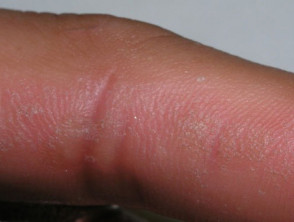
Dermal Duct and Eccrine Poro-Keratotic Ostial Nevus
PEODDN is usually evident from birth (a congenital mark), tending to manifest more clearly as the patient ages. However, there are case reports where PEODDN has begun to develop develop for the first time after puberty.
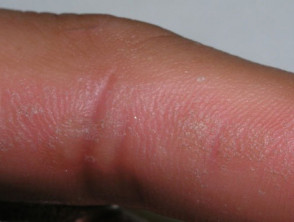
Clinically, PEODDN is distinguished by the presence of small papules cells y discrete, typically arranged in a linear configuration. The most frequent location for these lesions is the palm or fingers of the hand, or the sole or toes of the foot. Occasionally, they may extend to the back of these extremities. Rare cases have been documented presenting lesions extensive lesions covering significant areas of the body. Over time, PEODDN frequently acquires a more verrucous warty appearance and, notably, almost always persists regardless of the interventions applied.
Generally, PEODDN is asymptomatic, although in rare cases it may manifest with mild pruritus (itching).
What is the Recommended Treatment for PEODDN?
Therapies aimed at reducing the thickness of the warty skin in the affected area include:
- Keratolytic agents (e.g. creams formulations with salicylic acid, urea, or propylene glycol).
- Corticosteroids Topical retinoids (such as tretinoin).
- Corticosteroids steroids (for example, acitretin).
It is important to note that these treatments offer only partial efficacy.
For localized PEODDN localized, destructive methods can be employed, sometimes successfully. These include laser resurfacing laser (such as CO2 laser), dermabrasion, or Excision surgical excision of the affected area.
Since PEODDN is a persistent condition and often resistant to conventional treatments, consultation with a dermatologist is essential to establish a management plan appropriate for each patient's unique characteristics.