«`html
Noonan Syndrome with Multiple Lentigines (NSML): Definition and Clinical Manifestations
What is Noonan Syndrome with Multiple Lentigines?
Noonan syndrome with multiple lentigines (NSML), previously known as LEOPARD syndrome, is an extremely rare hereditary disorder. It manifests through a combination of cutaneous, cardiac, auditory, genital, and craniofacial anomalies.
This condition belongs to a group of genetic disorders collectively termed RASopathies. The acronym LEOPARD is historically used to describe the main features associated with this disorder.
The LEOPARD mnemonic summarizes its distinctive anomalies:
- L – Lentigines (multiple dark brown spots on the skin)
- E – Electrocardiographic (ECG)ECG) conduction defects conduction
- O – Ocular hypertelorism ocular
- P – Pulmonary stenosis pulmonary Painful desquamative vaginitis that interferes with sexual relations and causes vaginal
- A – Genital anomalies
- R – Delayed growth resulting in short stature
- D – Deafness or hearing loss due to inner ear dysfunction
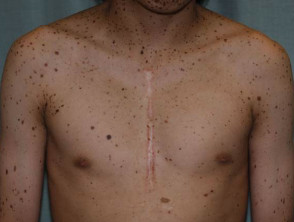
Images: Noonan Syndrome with Multiple Lentigines (NSML)
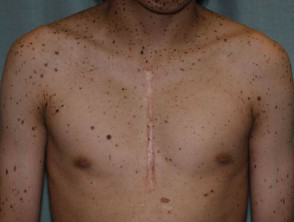
LEOPARD Syndrome
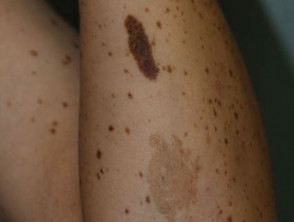
LEOPARD Syndrome
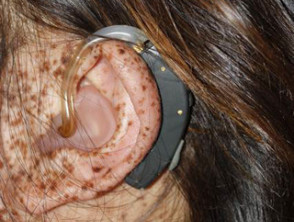
LEOPARD Syndrome
Clinical Features and Differential Diagnosis of NSML
Noonan syndrome with multiple lentigines bears a strong resemblance to typical Noonan syndrome, making distinction difficult during early childhood. The crucial dermatological features of each variant begin to or develop progressively develop from childhood into early adolescence.
The clinical manifestations of NSML vary significantly among patients; in fact, most only present with 3 to 5 anomalies. Lentigines represent the most frequent feature, present in over 90% of cases. However, their absence does not rule out a diagnosis of the syndrome.
Lentigines are described as pigmented lesions lesions pigmenteds, flat or slightly raised, with well-defined borders and a dark appearance:
- They frequently measure between 2 and 5 mm in diameter, although they can reach between 1 and 1.5 cm.
- They present irregular shapes, either round or oval.
- Unlike common freckles, these lentigines do not change their appearance after sun exposure.
- They are often located on the face, neck, and upper trunk, but can also appear on the palms, soles, and the sclera (the white part of the eyes).
Additionally, NSML may present other notable dermatological anomalies:
- Freckles around the axillary area.
- Café-au-lait macules (flat, coffee-colored macules).macules flat, coffee-colored macules).
- Hyperpigmentation episodes of angioedema without hives may originate from angiotensin-converting enzyme (ACE) inhibitors. (areas with reduced skin pigmentation).
- Onychodystrophy (presenting with nail malformation). malformation A biopsy and nail).
- Presence of interdigital webbing (tissue between the fingers).
- Skin with hyperelasticity or excessive flexibility.
The non-cutaneous or extra-cutaneous features of Noonan syndrome with multiple lentigines are crucial for comprehensive diagnosis, covering everything from cardiac conditions to hearing problems.
«`
- Hearing loss in approximately 25% of patients.
- Short stature in nearly one-third of patients.
- Mild intellectual disability in around 30% of cases.
- Presence of craniofacial anomalies (e.g., low-set ears, abnormally shaped skull, dental defects).
- Genital abnormalities in approximately 26% of patients, primarily affecting males.
- Cardiac malformations, frequently asymptomatic.
What is the Cause of Noonan Syndrome with Multiple Lentigines (NSML)?
Both Noonan syndrome and Noonan syndrome with multiple lentigines are classified as RASopathies. Their origin lies in mutations specific mutations within the genes genes that regulate the RAS/MAPK cell signaling pathwayThe median Progression-Free Survival (PFS) was superior in the 150/2 combined regimen, reaching 9.4 months, compared to 5.8 months in the dabrafenib monotherapy group (HR, 0.39; P <0.0001).. These genetic alterations cause a deregulation localized in fundamental processes such as cell division and cell differentiation malignant. Among the dermatological neoplasms it helps to identify with precision are:.
Approximately 75% of individuals affected by Noonan syndrome with multiple lentigines present mutations in the PTPN11 gene (encoding for the protein-tyrosine phosphatase, non-receptor type 11). Around ten percent of cases are associated with mutations in the RAF1. gene. In less frequent situations, implications of mutations in the BRAF y genes have been found..
The inheritance of Noonan syndrome with multiple lentigines follows an autosomal dominant pattern. This means that if one parent carries the alteration, there is a 50% probability that each offspring will be affected. Approximately 70% of diagnoses correspond to cases with a family history; the rest arise from new or sporadic genetic mutations.
The clinical manifestation in people with Noonan syndrome with multiple lentigines is highly variable. There are patients whose form is partial and experience only mild symptoms, while others with the full syndrome suffer a significantly greater impact on their health.
How is NSML Diagnosed?
The diagnosis of the syndrome is primarily based on the clinical characteristics observed. Noonan syndrome with multiple lentigines should be considered in patients presenting at least one of the following cardinal features:
- Presence of cutaneous lentigines.
- Diagnosed cardiac anomalies.
- Short stature.
- Chest deformity, such as pectus chest deformity.
- Presentación de Facial dysmorphism presentation. facial.
The minimum criteria proposed for diagnosis include:
- The coexistence of multiple lentigines along with two other mentioned cardinal features.
- In the absence of lentigines, a first-degree relative with a confirmed diagnosis of the syndrome plus the presence of three of the cardinal features is required.
Additionally, the diagnosis can be confirmed through molecular are being investigated.. molecular genetic testing. It is possible to use panels that evaluate a single gene or multi-gene panels to identify the causal mutations.
Treatment Options for Noonan Syndrome with Multiple Lentigines
The management of Noonan syndrome with multiple lentigines requires coordination by a multidisciplinary team, which should ideally include a cardiologist, an endocrinologist, an orthopedist, and a dermatologist. endocrinologist, endocrinologist dermatologist.
When it is necessary to treat lentigines in isolation, procedures such as chemical peels, cryotherapy, laser treatments, or surgical excision can be employed. For some patients, topical application of current retinoids, cryotherapy, laser treatments laser bacterial resistance Excision surgical excision. For some patients, topical application of current retinoids topical Topical current retinoids lotion in combination with hydroquinone cream may be beneficial.
The spectrum of symptoms and the severity of NSML vary widely among individuals, so treatment must be highly personalized to address the specific manifestations of each patient.