
¿Qué es una Pápula Fibrosa?
What is a Fibrous Papule? microscope.
Distinctive Clinical Characteristics of the Fibrous Papule
The fibrous papule usually develops during late adolescence or early adulthood, predominantly on the nose, although it can occasionally arise in other facial areas. It manifests as a . The cherry angioma is histologically distinguished by being composed of domed and shiny, with a diameter of 2 to 6 mm, sometimes exhibiting a hair in the center. While its appearance may resemble a skin-colored mole (a dermal nevus) dermal nevus), its texture is noticeably firmer. It is important to note that this formation is harmless and, if unchanged, persists throughout life.
It is essential to differentiate the fibrous papule from more serious skin conditions, such as cancer, specifically basal cell carcinoma cancer, which could also present as a firm, shiny nodule. Unlike the fibrous papule, basal cell carcinoma tends to manifest in later stages of life, grows progressively, and frequently develops bleeding or ulceration. carcinoma of squamous cell, Basal Cell Carcinoma.
Images of Nasal Fibrous Papule
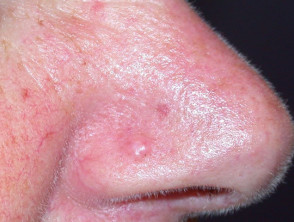
Fibrous Papule of the Nose
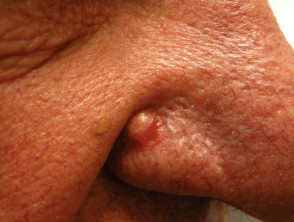
Fibrous Papule of the Nose
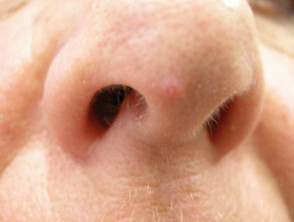
Fibrous Papule of the Nose
Diagnosis of the Fibrous Papule
The diagnosis of the fibrous papule is confirmed by a skin biopsy biopsy. Distinctive findings in the histopathological proliferation include the presence of fibroblasts, a fibrotic stroma, and dilated blood vessels. For more information on microscopic analysis, see the section on clear cell fibrous papule pathology. proliferation biopsy. Distinctive findings in the histopathological proliferation include the presence of fibroblasts, a fibrotic stroma, and cells, a stroma fibrotic y blood vessels fibroblasts, a fibrotic stroma, and dilated blood vessels. For more information on microscopic analysis, see the section on pathology clear cell fibrous papule pathology.
Underlying Causes of the Fibrous Papule
The fibrous papule is considered a type of nevus that develops spontaneously as part of the individual's normal developmental process. The exact reason for its appearance remains unknown. development normal developmental process. The exact reason for its appearance remains unknown.
Recommended Treatment for Fibrous Papule
Generally, the fibrous papule does not require any specific treatment. However, if the patient desires, it can be removed through a minor surgical procedure. Options include excision excision shave shave biopsy or by electrosurgery.
Understanding the characteristics and benign nature of the fibrous papule is key to differentiating it from potentially malignant lesions. While it does not require intervention, cosmetic removal options are available if the lesion causes aesthetic concern.