
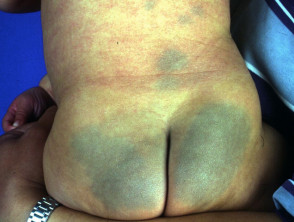
The Lumbosacral Dermal Melanocytosis, also known as a Mongolian spot, appears as a bluish-gray birthmark, typically located in the lumbar and gluteal region of newborns. This condition is one of the most common congenital skin markings.
Clinical Characteristics of Lumbosacral Dermal Melanocytosis
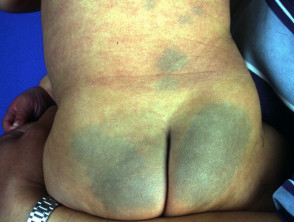
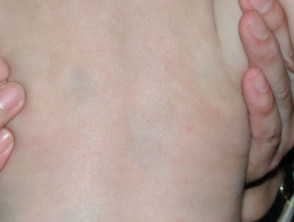
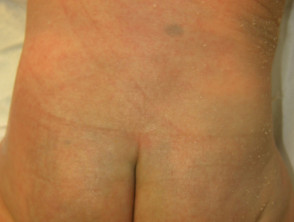
The main manifestation of lumbosacral dermal melanocytosis consists of bluish-gray patches located on the lower back or gluteal area. Although this is the most frequent location, dermal melanocytosis can appear in other areas of the body, such as the extremities or even the face. Generally, these patches measure a few centimeters, although they can reach larger dimensions. It is crucial to emphasize that the texture of the affected skin remains unchanged; only its pigmentation changes.
Visualization of Dermal Melanocytosis
Understanding the Etiology of this Pigmentary Disorder
It is postulated that dermal melanocytosis occurs due to a failure in the migration process of melanocytes—the cells responsible for producing pigment—during embryonic development. These cells become trapped within the dermal layer instead of migrating normally to the epidermis.
These marks are present from birth and their prevalence is significantly high, affecting more than 90% of infants of Mongoloid descent (including East Asian, Polynesian, Indonesian, and Micronesian populations). However, their incidence is lower in other racial groups.
Prognosis and Management Options for Dermal Melanocytosis
Dermal melanocytosis is considered an intrinsically benign condition, so it generally does not require any type of medical treatment. In the vast majority of cases, this skin discoloration fades naturally before the child reaches four years of age. Despite this, more extensive forms of dermal melanocytosis tend to be more persistent and may remain visible for many years or, in some cases, permanently.