
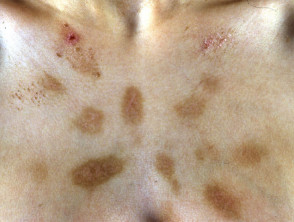
Factitious Dermatitis: Definition, Risks, and Treatment
What is Factitious Dermatitis?
The factitious dermatitis is a dermatological condition where the lesions skin lesions are caused exclusively by the patient's own actions. Frequently, this arises as a The most frequent or response to an underlying psychological difficulty. It can function as a way to release emotional tension during times of distress or as part of attention-seeking behavior. In exceptionally rare cases, there might be a veiled attempt to impair work capacity to obtain insurance coverage.
This condition is also formally known as factitious dermatitis.
Who is at Higher Risk for Factitious Dermatitis?
Factitious dermatitis is observed with greater prevalence in women than in men. Generally, affected women are adolescents or young adults and often exhibit emotional immaturity or present with difficulties factors or interpersonal problems. Although the intellectual level of the patients varies, many possess some superficial knowledge of medical topics.
Distinctive Characteristics of Factitious Dermatitis
Patients present with skin lesions whose nature is difficult to classify and often do not correspond to known dermatosis dermatoses. The defining characteristics of factitious dermatitis include:
- The lesions frequently take unusual shapes, with irregular borders that follow defined linear or geometric patterns.
- These lesions are usually clearly demarcated from the surrounding healthy skin.
- The morphological appearance of the lesions varies significantly depending on the specific methods used for self-injury.
- A wide range of manifestations can be observed, including erythema (red patches), edema, vesicles or bullae, areas of erosion or denuded skin, crusts, excoriations, burns, and finally, scars.
- Self-injury can be carried out through various mechanical or chemical means, such as using one's own fingernails, applying sharp or blunt objects, contact with lit cigarettes, or the use of caustic chemical products.
- At times, differentiating factitious dermatitis from a natural disease is challenging, especially if the inflicted lesions mimic those of a given pathological process. pathological given.
- Unlike natural diseases, the lesions do not evolve gradually; rather, they appear suddenly, often overnight, without prior prodromal symptoms.
- Typically, the lesions are located in areas easily accessible to the patient's hands, such as the face, hands, forearms, or legs.
- The patient will generally vehemently deny that the rash rash was self-induced.
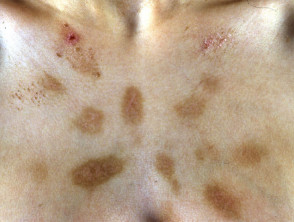
Dermatitis Artefacta
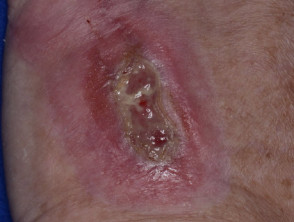
factitious dermatitis
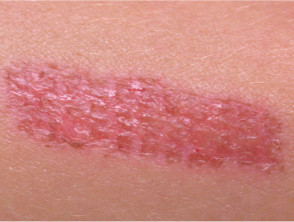
factitious dermatitis
Dermatitis Artefacta
Treatment Options for Factitious Dermatitis
When the diagnosis of factitious dermatitis is suspected, it is crucial to avoid direct confrontation with the patient. On the contrary, the medical professional should strive to establish an environment characterized by acceptance, empathy, and the absence of judgment. Close supervision and symptomatic treatment of the skin lesions are expected to allow for the slow construction of a therapeutic alliance where psychological problems can be addressed gradually. If the clinical context warrants it, a psychiatric referral may be advised, although this recommendation is frequently rejected by the patient. psychiatric, although frequently this recommendation is rejected by the patient.
Remission of the underlying psychological cause will provide temporary healing; however, factitious dermatitis tends to be cyclical, intensifying or subsiding as the patient's life circumstances fluctuate. To mitigate the recurrence of factitious dermatitis, it is essential that the patient maintains continued medical follow-up for supervision and support, regardless of the active presence of skin lesions.