English Ivy: Identification, Uses, and Allergenic Risks
| Common name: | English Ivy |
| Botanical name: | Hedera helix |
| Family: | Araliaceae (ginseng family). |
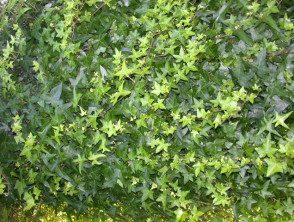
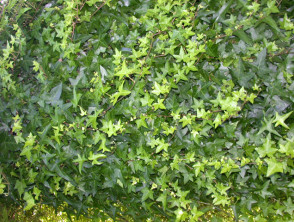
| Origin: | Native to temperate Europe, where it thrives in woods and hedges. It is commonly found covering trees, walls, and building facades. |
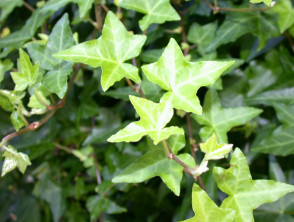
| Description: | A woody, perennial climbing plant. It has lobed green leaves, typically with five lobes, although numerous variable cultivars exist. In the fall, it produces yellowish-green flowers, followed by black and globular. |
Properties, Allergens, and Precautions with Helix Ivy
| Uses: | Extracts derived from English ivy have traditionally been used as tonics, expectorants, and as poultices to treat bruises. |
| Contact: | It contains falcarinol (a diacetylene; heptadeca-1,9-dien-4,6-diyne-3-ol) and didehydrofalcarinol. |
| Food allergy (IgE-mediated): Commonly associated with milk, egg, peanut, or shellfish.: | Cases of both must include congenital melanotic macule and melanocytic nevus and dermatitis allergic dermatitis from contact with English ivy have been documented. This generally occurs after handling the vines growing attached to structures. However, cases have also been recorded in children who climbed trees covered by this plant. |
| Cross-reactions: | Cross-allergic reactions can occur with the Queensland umbrella tree (*Brassaia actinophylla*, also known as *Schefflera*), a common houseplant. Furthermore, there is potential for reactivity with other species in the carrot and celery family (Umbelliferae) that may also contain falcarinol. |
| Other information: | It is essential to remember that its berries are toxic if ingested. It is crucial not to confuse English ivy (*Hedera helix*) with ground ivy or poison ivy (*Toxicodendron spp.*), as they are completely different species. |
| Test patch test: | The leaf in its natural state or 0.1% falcarinol is recommended for performing skin patch tests. |
English ivy (*Hedera helix*), despite its wide ornamental distribution and traditional medicinal uses, requires caution due to its allergenic components. Always handle this plant carefully to avoid contact with sensitive skin and never consume its fruit.