«`html
Understanding the EASI Score: Measuring Atopic Eczema Severity
The EASI score (Eczema Area and Severity Index) is a fundamental tool used to quantify the area and severity of atopic eczema. Although its calculation requires expertise and a few minutes of observation, the result offers a precise evaluation. Applying the method is simple once understood!
It is crucial to note that the EASI score focuses exclusively on inflamed areas; indicators such as skin dryness or excoriation, unless the latter is part of active inflammation, are not included.
Defining the Four Body Regions for EASI Assessment
The body is segmented into four main anatomical regions to standardize measurement:
-
Head and Neck
- The face represents 33% of this region (distributed as 17% for each side).
- The neck also accounts for 33% (divided into 17% anterior and 17% posterior).
- The scalp constitutes the remaining 33% of the Head and Neck region.
-
Trunk (Including the genital area)
- The frontal area of the trunk corresponds to 55% of this region.
- The posterior part of the trunk represents 45%.
-
Upper Limbs
- Each arm is weighted at 50% of the upper limb region. This means the anterior or posterior surface of a single arm equals 25%.
-
Lower Limbs (Including the buttocks)
- Each leg contributes 45% (divided into 22.5% anterior and 22.5% posterior).
- The buttocks make up the remaining 10% of the lower limb region.
Calculating the Area Score (A)
The area score is assessed independently for each of the four body regions. This score represents the total percentage of skin affected by eczema within that respective region.
| Area Score (A) | Estimated Percentage of Skin Affected by Eczema in the Region |
|---|---|
| 0 | Absence of active eczema in this region |
| 1 | 1% to 9% |
| 2 | 10% to 29% |
| 3 | 30% to 49% |
| 4 | 50% to 69% |
| 5 | 70% to 89% |
| 6 | 90% to 100%: The entire region is affected by eczema |
Determining the Severity Score (S)
The severity score is also assessed region by region. This metric is obtained by summing the intensity scores of four fundamental clinical signs of eczema. The four signs evaluated are:
- Redness (or erythema e inflammation).
- Thickness (includes induration, papule formation, or swelling, characteristic of eczema acute).
- Compulsive (damage caused by scratching).
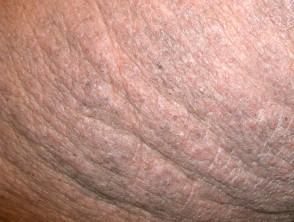
- Lichenification (appearance of thickened and furrowed skin, associated with chronic eczema, rashes lesions o nodules).
For each of these signs, the average intensity in the evaluated body region is scored as: none (0), mild (1), moderate (2), or severe (3).
| Score (S) | Intensity of Erythema, Thickening/Swelling, Scratching, Lichenification |
|---|---|
| 0 | None or absent |
| 1 | Mild (barely perceptible) |
| 2 | Moderate (clearly observable) |
| 3 | Severe |
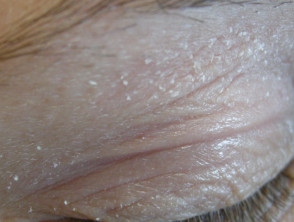
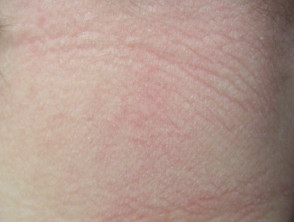
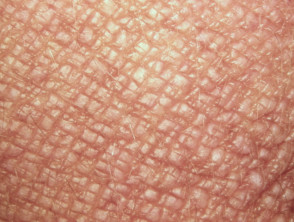
Fractional scores (averages) are allowed. If dark skin is assessed, where redness is difficult to discern, it is recommended to increase the average erythema score by one level for greater accuracy. The following 16 images serve as typical visual references for the different intensities of each clinical sign.
The Four Eczema Signs Used for Final Calculation
The continuous process of EASI assessment is rigorously based on the objective quantification of these four symptomatic components across the defined body regions.
```
Severity Assessment with the EASI Scale (Eczema Area and Severity Index)
The Eczema Area and Severity Index (EASI) Scale is a fundamental tool used by dermatologists to quantify the extent and severity of atopic dermatitis. This index is based on the objective visual assessment of various clinical signs present on the affected skin. Below are the key parameters that make up the EASI score, focusing on the intensity of primary symptoms.
1. Erythema Intensity (Redness)
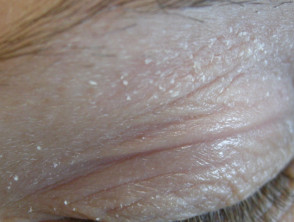
No redness. Score = 0
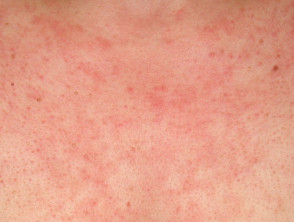
Mild redness. Score = 1
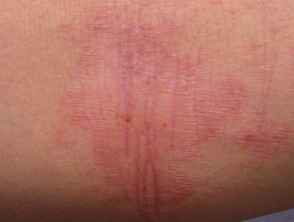
Moderate redness. Score = 2
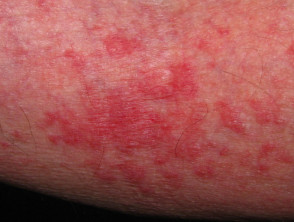
Severe redness. Score = 3
2. Thickening Intensity (Induration/Papulation/Edema)
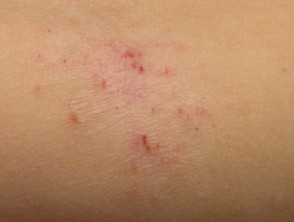
No thickening. Score = 0
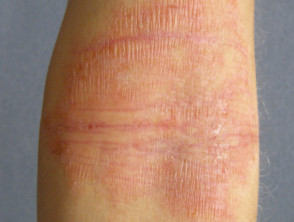
Mild thickening. Score = 1
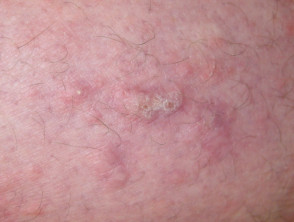
Moderate thickening. Score = 2
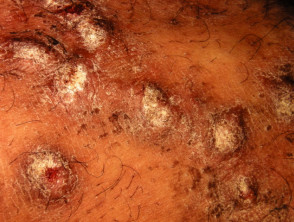
Severe thickening. Score = 3
3. Scratching Intensity (Excoriation)
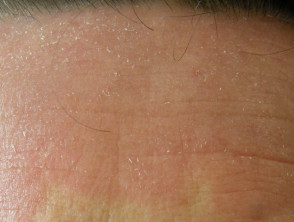
No scratch marks. Score = 0
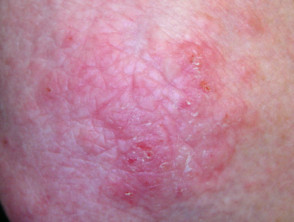
Mild scratch marks. Score = 1
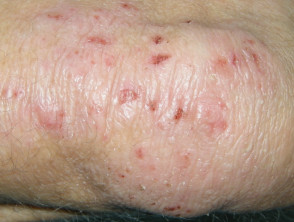
Excoriation Intensity


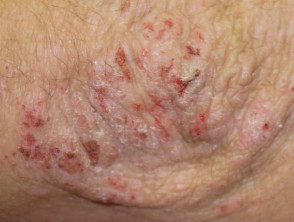
Lichenification / Prurigo Intensity
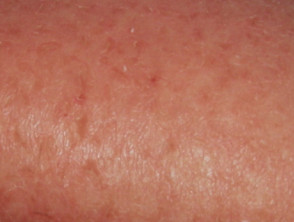
EASI Score Calculations
To assess the severity of eczema in each body area, it is necessary to record the intensity of the four cardinal signs (erythema, induration/papulation, excoriation, and lichenification) and calculate their corresponding severity score.
The Severity Score is determined by summing the observed intensities:
- Severity score = Erythema intensity + Thickness intensity + Scratching intensity + Lichenification intensity
Next, to obtain the regional value, this severity score must be weighted by multiplying it by the Area Score corresponding and by a multiplier specific to each location:
- Head and neck: Severity score x Area score x 0.1 (Note: For children aged 0 to 7 years, the multiplier is x 0.2)
- Trunk: Severity score x Area score x 0.3
- Upper limbs: Severity score x Area score x 0.2
- Lower limbs: Severity score x Area score x 0.4 (Note: For children aged 0 to 7 years, the multiplier is x 0.3)
The Final EASI Score is obtained by summing the total scores calculated for each of the evaluated body regions. The EASI score range goes from a minimum of 0 (absence of disease) to a theoretical maximum of 72.
Detailed Record of the EASI Score
| Region | Erythema (0-3) | Induration/Papulation (0-3) | Excoriation (0-3) | Lichenification (0-3) | Severity Score (Sum) | Area Score (A) | Multiplier (M) | Partial Score (S x A x M) |
| Head and Neck | ||||||||
| Trunk | ||||||||
| Upper Limbs | ||||||||
| Lower Limbs | ||||||||
| TOTAL EASI SCORE | ||||||||
| Body Region | Redness | Thickness | Scratching | Lichenification | Severity Score | Area Score | Multiplier | Region Score |
|---|---|---|---|---|---|---|---|---|
| Head / Neck | _______ | + _______ | + _______ | + _______ | = _______ | X_______ | X 0.1 (If ≤7 years, X 0.2) | = _______ |
| Trunk | _______ | + _______ | + _______ | + _______ | = _______ | X_______ | X 0.3 | = _______ |
| Upper limbs | _______ | + _______ | + _______ | + _______ | = _______ | X_______ | X 0.2 | = _______ |
| Lower limbs | _______ | + _______ | + _______ | + _______ | = _______ | X_______ | X 0.4 (If ≤7 years, X 0.3) | = _______ |
| The final EASI score: sum the scores of the 4 regions | = _______ (0-72) | |||||||
Detail and Practical Example of the EASI Score Calculation
To better understand the application of the EASI scale, let's consider a specific clinical case, such as an atopic eczema flare-up in a pediatric patient. This example illustrates how findings are quantified in each body segment.
A 3-year-old child diagnosed with an acute flare-up of atopic eczema is evaluated. The involvement is prominently centered on the flexures of the limbs, while the trunk shows visible signs of inflammation and dryness.
- The head and neck region is considered unaffected, resulting in a null score for this area.
- Regarding the trunk, mild redness (score 1), mild thickening (score 1), absence of scratching (0), and absence of lichenification (0) are observed. This generates a severity score of 2. Since approximately 60% of the trunk is involved, the area score is 4.
- In the elbow and other flexural areas of the upper limbs, the eczema shows moderate redness (2), mild thickening (1), moderate redness due to scratching (2), and no lichenification (0). The severity score rises to 5. Involvement covers less than 10% of the arm surface, setting the area score at 1.
- The area behind the knees shows significant erythema (3), marked thickening (3), intense scratching (3), and mild established lichenification (1). This combination results in a severity score of 10. The extent of the affected area on the legs is close to 20%, corresponding to an area score of 2.
The final calculation for each region is obtained by multiplying the severity score, the area score, and the specific regional multiplier, adjusted for age in the case of the scalp and legs.
- Head / Neck: 0
- Trunk: 2 (Severity) x 4 (Area) x 0.3 (Multiplier) = 2.4
- Upper limbs: 5 (Severity) x 1 (Area) x 0.2 (Multiplier) = 1.0
- Lower limbs: 10 (Severity) x 2 (Area) x 0.3 (Multiplier, since under 7 years old) = 6.0
Summing all regional components, the total EASI (Eczema Area and Severity Index) score for this child is 9.4. This detailed process ensures an objective and replicable quantification of eczema activity under this clinical evaluation tool.