Definition and Application of Convolutional Neural Networks (CNN)
A convolutional neural network (CNN) is a specialized type of deep artificial intelligence neural network, fundamentally applied to image processing. [1]. This network ingests an input image and, using a pre-existing image catalog, generates an output that classifies or matches said image. A neural network is inspired by the synaptic interconnections of the neurons biological ones, structuring itself to learn and optimize its performance as it processes more images and executes convolution iterations—where inputs from a new image are combined with those already cataloged to produce a result.
CNNs represent an innovative tool of great value for dermatologists, facilitating a more precise diagnosis of lesions. The process a CNN follows to generate a diagnosis from an image is analogous to the methodology employed by a dermatologist professional: the diagnosis of skin lesions begins with an input image (of a . The cherry angioma is histologically distinguished by being composed of cutaneous), which is processed through a «processing network» (the skills and knowledge of the dermatologist analyzing and synthesizing the information) to produce a diagnostic ‘class’ or a ‘class probability’ (mucous membranes.). [2]
The visual essence of dermatology aligns perfectly with the use of digital images of skin lesions, giving CNNs disruptive potential in medical practice. This field is multifaceted, as it demands data analysis through complex mathematics and requires high computational capacity to integrate principles of biology, mathematics, and computer science.
Who Uses Convolutional Neural Networks?
CNNs have found application in both military and civilian contexts, including advanced systems in vehicles unmanned aerial vehicles, the technology sector, and retail. [3] They manifest in everyday tools, such as social media platforms that automatically identify faces, photo galleries with automated tagging, and e-commerce sites that offer personalized suggestions based on user browsing patterns.
In the medical field, researchers are applying CNNs to diagnose pathologies such as diabetic retinopathy, arrhythmias arrhythmias and various types of skin cancer. [3–5]
Delving into the Operation of Convolutional Neural Networks
The operational foundation of a CNN lies in its computational ability to discern between different image categories based on the identification of distinctive and reliable features, such as edges or curves. This fundamental core gradually expands through the extraction of more complex attributes, which accumulate sequentially through successive layers of convolutional processing and pooling.
Step 1: Convolutional Layers
A digital image is entered into the system and interpreted as various pixel matrices, encoded by their color values. This process involves transforming specific sections of the image by applying a predefined filter. [2] Frequently, filters begin their work by analyzing simple visual features, such as straight lines, diagonals, curves, or focal points. Each time one of these filters overlaps and processes the original image, a derived and usually smaller representation of the initial photograph is generated.
```html
Rules and Steps for Image Processing with CNN
In the analysis, positive matches of the filter receive a high score, while areas that do not match obtain a value less than 1. This generates a complex representation of the image. For example, if a filter designed to detect straight lines is applied to a dermatoscopic image of an acral nevus that presents parallel furrows, a strong positive convolution activation will occur. This procedure can be repeated using multiple filter functions to refine the result and obtain a more accurate diagnosis or differential diagnosis.
Step 2: Pooling Layer
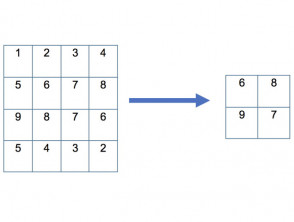
If the resulting image is large, successive layers of the neural network might require a "pooling" stage between convolution operations. This technique focuses on an area of interest within the image, discarding surrounding information [2]. There are various pooling modalities, with the maximum pooling method being the most frequently implemented (see the subsequent figure).
A simple method of "maximum pooling" of a 4 x 4 image into a 2 x 2 pool
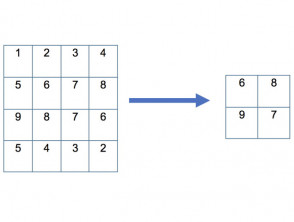
A simple method of "maximum pooling" of a 4x4 image into a 2x2 pool
An additional normalization step is also frequently incorporated. This is a standard technique used to boost the performance and stability of the neural network. Normalization standardizes the inputs traversing the network, ensuring that each input maintains approximately the same scale. This way, the neural network avoids assigning undue importance to an input filter simply because it has a larger magnitude due to scale differences. This process substantially increases the network's learning speed.
Step 3: Output Layer
To generate the required differential diagnosis for a suspicious lesion, the neural network must apply a fully connected layer based on the analysis performed by all previous layers. This process is analogous to how a dermatologist synthesizes various initial clinical signs to arrive at a provisional diagnosis accompanied by its set of differential diagnoses.
Subsequently, the CNN can undergo training using advanced functions to optimize its accuracy. This allows it to "self-correct," identifying new lesions through mechanisms like backpropagation, which adjusts the weights assigned to features when the network produces a misclassification [1].
Notable Advantages of Convolutional Neural Networks (CNN)
The benefits associated with using CNNs in diagnosing skin conditions center on accuracy, speed, and cost reduction.
- The accuracy of clinical diagnosis for melanoma intrinsically depends on the experience and training of the examining physician. However, CNNs have demonstrated the ability to match the performance of board-certified dermatologists in specific contexts, and their accuracy is expected to continue improving in the future [6,7].
- Currently, CNNs require only seconds or minutes to issue a diagnosis when analyzing an image of a skin lesion. Inputs, algorithms, and results can be processed outside of regular business hours and be accessible to anyone with an internet connection. It is important to contrast this brief time frame with the waiting and travel times necessary to get an appointment with a dermatologist, which frequently exceed several months.
- The algorithms demonstrate adaptability and have the capacity to continuously learn as new images are incorporated.
- It is projected that CNNs will diagnose lesions for a fraction fraction of the cost associated with a traditional dermatological consultation.
Challenges and Considerations in Using Convolutional Neural Networks
Limitations associated with the application of CNNs include managing unrealistic expectations from patients and healthcare professionals, concerns regarding security and privacy, in addition to inherent medical-legal liability.
- There is great optimism surrounding CNN technology, but its true benefits will take time to fully materialize. It is essential to have vast amounts of data and inputs for the proper "training" of CNNs. Likewise, human oversight remains indispensable.
```
- It is crucial to establish a clear framework for selecting which lesions will be analyzed and examined by CNNs, and to ensure that the involved healthcare professionals receive adequate training for their use.
- Both Convolutional Neural Networks (CNNs) and any diagnostic support tools they provide must obtain official approval as medical devices, requiring continuous revalidation as their algorithms are updated and expanded. [8].
- It is foreseeable that CNNs will operate entirely online, making intensive use of cloud storage. This demands robust cybersecurity systems to ensure backups against database or server failures, along with rigorous authentication processes to prevent unauthorized access. Encryption and secure transfer protocols must be implemented for the storage of personal health data, and research must be strictly limited to the use of anonymized data.
- Healthcare professionals using CNNs must be aware that performance demonstrated with a specific dataset is not universally applicable to others. Misdiagnoses will inevitably occur, including false positives (over-diagnosis of lesions benign and and even) and false negatives (such as missing cancer diagnoses). cancer).
- The medical-legal liability of healthcare professionals who rely on results generated by CNNs needs urgent clarification, given the absence of notable precedents. The key question arises: Can a computer algorithm be held legally responsible for an incorrect diagnosis or a missed diagnosis case?