Understanding Contact Urticaria: Symptoms and Causes
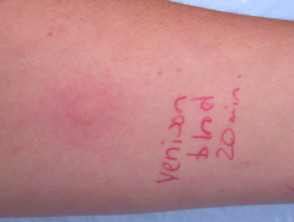
The contact urticaria manifests as localized, immediate, and transient swelling and redness on the skin, resulting from direct contact with an irritating or allergenic substance. It is crucial to differentiate this reaction from contact dermatitis, which develops its effects hours or days after exposure to the offending agent.
This skin condition can be classified as immunological, due to an contact underlying condition, or non-immunological. Essentially, it is a manifestation of inducible urticaria. inducible.
Illustrative Images of Contact Urticaria
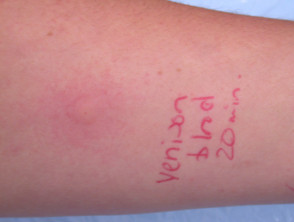
Deer test
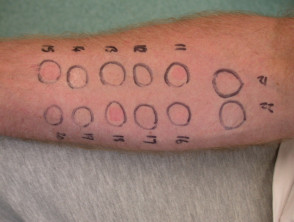
Prick test
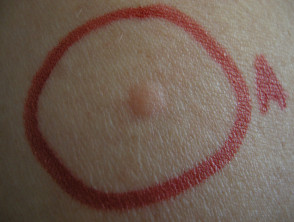
Reaction to latex
Who is at Risk of Developing Contact Urticaria?
Although anyone can experience contact urticaria, certain occupational groups face a significantly higher risk of developing this condition. In most of these cases, repeated exposure over time induces an immunological.
Below are the at-risk occupational groups and common substances that trigger the allergic reaction:
- Agricultural and dairy workers: Exposure to cow dander, cereals, and feed.
- Bakers: Sensitivity to ammonium persulfate, flour, and alpha-amylase.
- Dental workers: Contact with latex, acrylate and epoxy resins, and dental pastes.
- Electronics workers: Reactions to acrylate and latex.
- Food service workers: Exposure to products such as cheese, egg, milk, fish, seafood, fruit, and wheat.
- Hairdressers: Sensitivity to ammonium persulfate and latex.
- Medical/veterinary workers: Latex is a common irritant in this sector.
Triggers of Contact Urticaria
The onset of contact urticaria is provoked by a wide range of agents, including specific foods, chemical preservatives, fragrances, plant and animal derivatives, metals, and natural rubber latex. The biological mechanism behind the rapid hives rash rash observed in the exposed area is fundamentally classified into two mechanisms:
non-immunological contact and immunological (allergic) contact urticaria.
- Non-immunological contact urticaria generally causes mild localized reactions that resolve within a few hours, such as a rash from contact with nettles. This type of urticaria manifests without the patient's immune system having been previously exposed to an contact allergen.
- Immunological contact urticaria is more common in atopic atopic individuals (people predisposed to allergies). Therefore, it requires prior exposure to the allergen for this type of contact urticaria to develop.
Below are the most common triggers for the different types of contact urticaria.
Frequent Causes of Non-Immunological Contact Urticaria
- Ingredients present in cosmetics and medications, such as:
- Peru Balsam
- Benzoic acid
- Cinnamic alcohol
- Cinnamaldehyde
- Sorbic acid, a preservative widely used in various foods.
- Ingestion of raw meat, fish, and vegetables.
Common Triggers of Immunological Contact Urticaria
- Natural rubber latex (e.g., surgical gloves).
- Various antibiotics.
- Certain metals, such as nickel.
- Parabens.
- Benzoic and salicylic acids.
- Polyethylene glycol.
- Short-chain alcohols.
- Consumption of raw meat, fish, and vegetables.
Clinical Manifestations of Contact Urticaria
Contact urticaria rashes typically appear between minutes and approximately one hour after the irritating substance contacts the skin. Signs and symptoms in the affected skin areas include:
- Localized sensation of stinging, tingling, or intense itching.
- Localized or generalized red swellings, widespread, hives wheals, particularly on the hands. The severity of redness and swelling varies from slight erythema with minimal swelling to significant redness accompanied by tight wheals.
- The rash generally resolves on its own within 24 hours of appearance.
Signs and symptoms can manifest in organs other than the skin. These are called extracutaneous reactions and are more likely to occur in patients with immunological contact urticaria. Characteristics of these extracutaneous reactions include:
- Wheezing (bronchial asthma).
- Runny nose and watery eyes.
- Lip swelling, hoarseness, and difficulty swallowing.
- Gastrointestinal symptoms such as nausea, vomiting, diarrhea, and cramps.
- In severe cases, anaphylactic shock may occur targetoid-like (which constitutes a life-threatening emergency).
Contact Urticaria Visualized
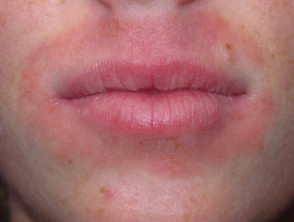
Perioral contact urticaria
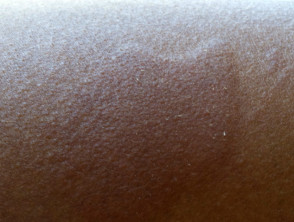
Hives on dark skin
Diagnosis of Contact Urticaria
Sometimes, contact urticaria is easily recognizable and does not require specialized testing. When feasible, RAST tests (specific IgE blood tests) can be used to confirm the underlying allergy. Skin prick tests and patch tests are essential tools to confirm the diagnosis of contact urticaria, although they do not distinguish on their own between allergic and non-allergic mechanisms. patch are essential tools to confirm the diagnosis of contact urticaria, although they do not distinguish on their own between allergic and non-allergic mechanisms.