
| Common Name: | Chrysanthemum |
| Botanical Name: | X Dendranthema |
| Family: | It belongs to the extensive Asteraceae group (formerly known as Compositae). |
| Origin: | The Chrysanthemum genus represents a hybrid lineage intensely cultivated in Asia for over two millennia. Initially valued in China as a medicinal plant, these flowers have become globally popular, driving the creation of numerous societies dedicated to their horticulture. The genus encompasses over 200 distinct species, including annual varieties, small shrubs, and herbaceous perennials. |
| General Description: | Botanically, chrysanthemums are related to other popular flowers such as dahlias, sunflowers, marigolds, zinnias, and cosmos. Each visible floral structure is actually composed of hundreds of tiny flowers called florets. These are classified into disk florets and ray florets. In varieties that mimic the daisy shape, the outer sections are ray florets and the central eye is formed by the disk florets. |
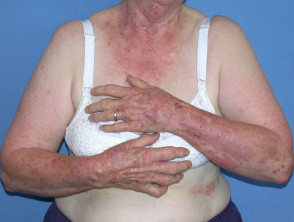
Airborne Contact Dermatitis Caused by Chrysanthemum Allergy
Chrysanthemum allergy can be triggered by exposure to airborne pollen.
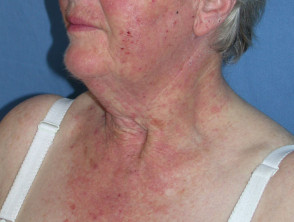
There is an allergic risk when handling or being near chrysanthemum flowers.
| Historical and Ornamental Uses: | Today they are primarily used as floral ornaments. However, ancient Chinese attributed vitality properties to them. Historically, medicinal uses were recorded where boiled roots served to relieve headaches, and both petals and tender buds were incorporated into salads; additionally, their leaves were fermented to create a ceremonial drink. |
| Allergenic Components: | Chrysanthemums release a range of allergenic substances, with sesquiterpene lactones being the most significant compounds. These allergens are deposited on the surfaces of the flowers and leaves, frequently adhering to trichomes (plant hair structures), which facilitates their environmental dispersal. |
| Manifestation of the Allergy: | Contact dermatitis caused by chrysanthemum usually manifests initially on the fingertips, generally when removing flower buds, but it tends to spread to the forearms and face. In certain cases, this condition can become chronically persistent and has been linked to the development of chronic actinic dermatitis (an advanced form of photosensitivity). The chrysanthemum is the main cause of occupational dermatitis within the Asteraceae family, affecting florists and horticulturists, although amateur gardeners are also vulnerable. Furthermore, the appearance of contact urticaria sensitive to touch has been documented, which presents as an itchy rash that arises a few minutes after direct contact and usually disappears around an hour later. |
| Possible Cross-Reactions: | If you have been diagnosed with a chrysanthemum allergy, it is essential to eliminate all display of these flowers and other members of the Asteraceae (Compositae) family, both inside the home and in the garden. This is because minimal concentrations of the allergen carried in the pollen can trigger an adverse reaction on sensitive exposed skin. |
| Additional Information: | |
| Diagnostic Method: | The patch test is the tool used to detect the presence of sesquiterpene lactones. |
Understanding the nature and allergens associated with the chrysanthemum is crucial, especially for those in occupations close to these plants. Monitoring exposure and carrying out appropriate patch tests can significantly minimize skin symptoms associated with this popular ornamental flower.