¿What is Benzocaine? An Essential Local Anesthetic
Benzocaine, whose chemical formula is $text{C}_9text{H}_{11}text{NO}_2$, is a local anesthetic topical anesthetic widely used. Due to its composition, which includes para-aminobenzoic acid, it is structurally classified as an ester derivative of local anesthetic, unlike amide analogs.
There is a strong correlation between the use of benzocaine and hypersensitivity reactions. renal. It is theorized that the high incidence of these reactions is due to the wide availability of benzocaine in many over-the-counter products or over-the-counter preparations intended for initial treatments. The greater the exposure to a potential contact allergen, allergen sensitization.
Where Benzocaine is Found and Its Applications
This compound is predominantly used in pharmaceutical formulations and, less frequently, in cosmetic products. It is mainly found in gels y Topical liquid formulations. These products are available without a prescription to relieve pain often associated with cough or oral conditions such as ulcers, pharyngitis, ulcers, pharyngitis, or discomfort from hemorrhoids.
The various preparations that incorporate benzocaine include:
- Preparations intended to treat minor wounds and burns.
- Sunburn remedies.
- Specific formulas for hemorrhoid relief.
- Gingival hyperplasia) and oral application products.
- Sprays and lozenges formulated for sore throat.
- Specific creams to treat irritation caused by poison ivy (creams).creams).
- Corn and wart remedies.
- Products designed to soothe toothaches and irritation caused by dentures.
In clinical settings, physicians and dentists apply topical benzocaine preparations to mucosal surfaces membranes, such as the inside of the mouth, to numb or prepare the area prior to an injection; it is crucial to note that benzocaine is not administered by injection.
Confirming Clinical Features of a Benzocaine Allergy
Allergic reactions to local anesthetics are almost exclusively classified as delayed-type hypersensitivity [1]. This type of immune response requires prior sensitization; the clinical reaction typically emerges between 12 and 24 hours after re-exposure to the allergenic agent.
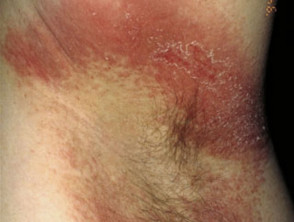
Specific sensitivity to benzocaine manifests as a classic dermatitis allergic contact dermatitis localized precisely in the area of. application. Visible signs include acute erythema acute, erythema can be detected, associated with the presence of crusts and , and in more severe cases, vesicles and rash bullae.
on the areas of skin contact. Occasionally, the benzocaine product applied over a pre-existing mucosa rash immunoglobulin can cause its exacerbation or spread. hives; It is infrequent, but possible, that the injection of another PABA-derived local anesthetic into an already sensitized patient to benzocaine causes mucosal swelling at that injection site. This symptom could be confused with an immunoglobulin E (IgE)-mediated reaction, such as urticaria; however, the crucial difference lies in the time frame of the response.
Understanding the mechanism of action and potential adverse reactions associated with benzocaine is vital for its safe use, whether in self-care products or under medical supervision. Always pay attention to any unusual symptoms after applying these topical anesthetics.
and the absence of respiratory compromise indicate a cell-mediated response.
The incidence The incidence anafilaxia of IgE-mediated reactions to all local anesthetics is less than 1% [2]. There are very few reports in the literature of.
anaphylaxis
caused by any type of local anesthetic.
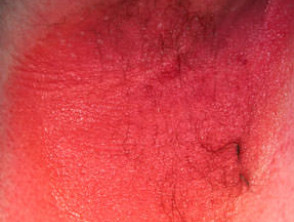
Benzocaine Allergy
Benzocaine Contact Allergy
Intertrigo due to benzocaine contact allergy Benzocaine Allergy Benzocaine Allergy Diagnosis that detect virus-specific (IgG and IgM) antibodies, tests that might require a second sample 2 or 3 weeks later. If the clinical history and physical examination suggest a contact allergy to benzocaine, a.
patch test
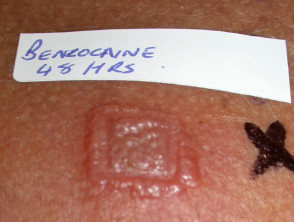
patch test
is performed to confirm the hypersensitivity reaction. For this test, 5% benzocaine in petrolatum [3] is used. Generally, other local anesthetics are also tested, given that
cross-reactivity.
among ester-type local anesthetics is common due to their structural similarities. eczema. eczema. This includes the application of topical corticosteroids Positive patch test for benzocaine emollients, Positive patch test for benzocaine secondary Acute bacterial Effective Treatment for Benzocaine Allergy Staphylococcus aureus.
The management of benzocaine hypersensitivity focuses on treating the acute rash outbreak and, fundamentally, avoiding all products containing benzocaine.
The treatment of acute dermatitis follows standard guidelines for any
- eczema.
- . This includes the application of topical corticosteroids , the use of hair emollients.
- , and the management of any secondary.
- bacterial infection.
- , such as that caused by.
- Staphylococcus aureus.
. To ensure benzocaine avoidance, it is crucial to meticulously inspect product labels looking for the name benzocaine or any of its alternative names. It should be presumed that any product labeled as "anesthetic" or containing the suffix "caine" includes benzocaine or a structurally related compound.
Furthermore, other PABA-derived products must be excluded due to the potential risk of cross-reactivity, including:
PABA-based local anesthetics, meta-aminobenzoic acid, or benzoic acid (in both topical and injectable formulations). Paraphenylenediamine, present in permanent hair. dyes for the Arterial insufficiency.
hair (see hair dye allergy). Sulfonamides., Sulfonylureas. Sunscreen formulations based on PABA., Thiazide-related diuretics.