Understanding Onychocryptosis: Causes and Stages of Ingrown Toenails
A ingrown toenail represents a considerably painful podiatric condition that arises when the edge or corner of the toenail embeds deeply into the surrounding soft tissue. Although it commonly affects the outer edge of the big toe, this problem can manifest on any of the toes, on one or both sides.
Technically, this condition is known as onychocryptosis.
Triggering Factors for Ingrown Toenails
There are multiple factors that contribute to the development of ingrown toenails, with two main causes standing out: the use of improper footwear and incorrect nail trimming technique. and nail.
- Restrictive Footwear: The continuous use of shoes that are too tight, high heels, or narrow-toed styles compresses the toes, forcing the nail edge to penetrate the side skin, preventing its natural growth.
- Improper Nail Trimming: Trimming nails in a rounded or excessively short manner allows the edges to dig into the skin. It is crucial to trim nails straight across to keep the top flat.
- Trauma: Any injury near the nail, such as a blow or a tear at the edge, can predispose one to developing an ingrown toenail.
- Fungal Infections: The Unlike other Fungal infections can cause the toenail to become thicker or wider, favoring the development development of this complication.
- Specific Medications: Certain prescription drugs, especially oral Topical retinoids like isotretinoin and acitretin, have been associated with this condition.
- Abnormal Nail Morphology: Pre-existing conditions such as pincer nails or trumpet nails represent a chronic structural vulnerability.
Staging Classification: Signs and Symptoms of Onychocryptosis
Ingrown toenails are segregated into three progressive levels, dictated by the severity of the symptoms presented on the affected toe.
Stage 1: Initial Presentation
- Mild redness of the toe tip, accompanied by slight swelling.
- Sensation of warmth and pain upon direct contact.
- Absence of purulent discharge or visible drainage.
Stage 2: Signs of Infection
- Redness, swelling, and pain intensify noticeably.
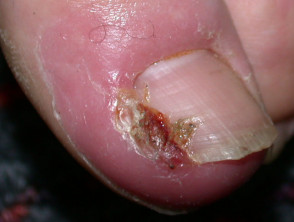
- Possibility of observing tissue or or yellowish/white drainage in the affected area.
- Indicates that a secondary localized infection has likely set in.
Stage 3: Severe Involvement and Complications
- Exacerbation of cardinal symptoms: redness, swelling, and pain.
- Formation of granulation tissue, which contributes to inflammation and causes discharge persistent purulent discharge.
- cells (arrowhead) and a outer hypertrophy of the nail fold (excessive growth of surrounding skin tissue).
- Risk of developing more serious infections, potentially accompanied by systemic fever. fever Arterial insufficiency.
Ingrown Toenails
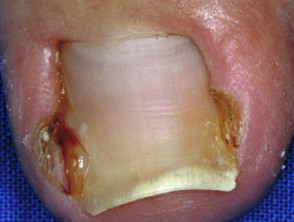
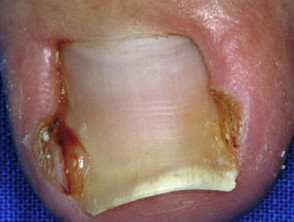
Ingrown Toenail
To properly manage onychocryptosis, it is essential to identify the stage of development and apply consistent preventive measures, such as correct filing and choosing appropriate footwear. If you experience symptoms of Stage 2 or 3, immediate professional intervention is recommended.
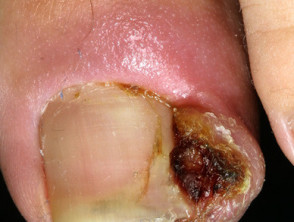
Pseudo-Ingrown Toenail in Newborns
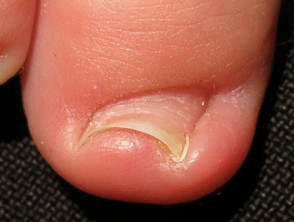
Around 2% of babies are born with what appears to be an ingrown toenail because the growth of the nail plate is very short. Fortunately, this condition rarely causes pain. The appearance usually normalizes on its own in about a year.
Identification of Pseudo-Ingrown Toenails
Ingrown Toenail
Treatment Options for an Ingrown Toenail
The appropriate treatment for an ingrown toenail fundamentally depends on the stage and severity of the condition. However, regardless of the degree, it is crucial that the patient avoids tight or high-heeled footwear. Whenever feasible, wear sandals until the condition completely improves.
Ingrown toenails classified as Stage 1 should be managed conservatively using the following home care techniques:
- Warm Water Soaks: Soak the affected foot in warm water approximately four times a day.
- Local Hygiene: Wash the foot, including the inflamed area, twice daily with mild soap and water.
- Lifting the Nail Edge: After each soak, carefully lift the edge of the nail that is embedding into the skin. Insert a small piece of rolled cotton, thin gauze, dental floss, or dental tape between the nail and the soft tissue. This helps keep the nail elevated, although it may cause some discomfort initially.
For Stage 2 ingrown toenails, the use of systemic antibiotics or topical treatments may be necessary. The combination of topical antibiotic ointments along with local anesthetic agents can speed up the healing of the toe and provide significant pain relief by numbing the affected area. Only if the condition progresses or conservative measures fail might surgical removal of the ingrown toenail be considered.
Stage 3 ingrown toenails frequently require surgical intervention. The most successful procedure is generally lateral nail avulsion combined with partial matricectomy. This procedure is briefly described below:
- A ring block with local anesthesia is administered to completely numb the affected toe.
- Any pus accumulation present at the tip of the toe is drained.
- The section of the ingrown toenail is cut to establish a clean, straight edge.
- Electrocautery or phenol ablation is used to destroy the matrix cells beneath the area where the nail plate has been sectioned, thus preventing future growth of the problematic portion of the nail.
- Any excessive or hypertrophied granulation tissue must also be removed during surgery.
- An antibiotic ointment is applied and the toe is bandaged until complete healing occurs, which usually happens within a few weeks.
It is essential to rigorously follow the following postoperative care to ensure a successful recovery:
- Starting on the second day, carefully remove the bandage and proceed to wash the area with soap and water.
- Gently dry the area and reapply the prescribed antibiotic ointment, placing a new bandage, once or twice daily for a minimum of one week after the surgical procedure.
- For pain management, you can take acetaminophen or other analgesics recommended or prescribed by your specialist.
- Keep the toe clean and dry at all times. Avoid swimming, bathing, or submerging the toe in water for at least two weeks post-surgery; brief showers are permitted.
- Restrict high-impact activities such as running or jumping for the two weeks following surgery.
- Contact your doctor immediately if you experience signs of infection or if the pain is not controlled with medication.
Properly managing ingrown toenails, whether through early home care or professional treatment, is vital to prevent serious complications and restore comfort when walking.
- Consult your doctor if you experience increased pain, swelling, redness, or unusual discharge in your toe.
Other Treatment Strategies for Ingrown Toenails
For managing an ingrown toenail, a technique using a splint or gutter is sometimes employed. This can be a piece of cut plastic tubing placed to mechanically separate the nail from the lateral skin folds. These temporary devices are secured using adhesive tape or acrylic cement. Additionally, it is possible to mold an artificial nail using moldable acrylic resins as a solution temporary cosmetic solution.
Chemical or medical nail avulsion represents a progressive and painless method for removing damaged nail tissue. However, since this procedure removes the entire nail, its application is infrequent in the specific context of ingrown toenails.
There are described alternative surgical procedures that involve the removal of the soft tissue surrounding soft tissue and reduction of the distal phalanx distal to relieve pressure.
How Can Ingrown Toenails Be Prevented?
Adopting simple and consistent routines can be extremely effective in preventing the appearance of ingrown toenails. Pay attention to the following key foot care recommendations:
- Trim toenails following a straight line; avoid cutting them excessively or curving the edges.
- Wear footwear that fits the foot correctly, without being tight.
- Be sure to keep feet consistently clean and dry to promote skin health.