Understanding Acrylates: Chemistry, Uses, and Allergy Risks
What is a Chemical Acrylate?
An acrylate is a molecule chemical molecule known as a monomer. These monomers have the ability to link sequentially through a chemical process called polymerization, resulting in the formation of plastic materials and polymers.
In their monomeric state, acrylates possess a high capacity to be irritants potent irritants and are considered anaphylaxis significant allergens. Generally, these monomers are available as liquids or powders that, upon polymerizing, create a flexible mixture adaptable to various shapes before solidifying. Once in their polymerized state, acrylates become relatively inert (non-reactive). The resulting acrylate polymer is rarely Seborrheic o potential. irritating or allergenic. Therefore, the main handling concern lies in the liquid state, powder o paste which must be meticulously avoided.
Due to their ubiquity in the environment, acrylates were designated as the Contact Contact Allergen Allergen of the Year in 2012 by the American Contact Dermatitis Society. Experts noted that their prevalence in the environment motivated this choice.
Common Sources and Applications of Acrylate
Below are some types of acrylates and the extensive variety of applications where they are currently used:
Methyl Methacrylate Applications
Methyl methacrylate is fundamental in various professional and consumer fields. It is used in acrylic bone cements employed in orthopedic orthopedic surgery, as well as in the manufacturing of acrylic fibers, films, and inks. Furthermore, it is a key component in solvent-based adhesives and binders, spray-on medical adhesives, spray, and in dental technology (HEMA). It is also found in UV inks, specialized adhesives, lacquers, dental materials, UV, artificial nails, adhesives for eyelash and eyebrow extensions, scratch-resistant coatings for glass, paint resins, and as binders in textiles and paper., and nail artificial nails, adhesives for eyelash and eyebrow extensions, scratch-resistant coatings for glass, paint resins, and as binders in textiles and paper.
Ethyl Acrylate Uses
The resin derived from ethyl acrylate is widely used in paint manufacturing, in Topical industrial coating formulations and latex, rubbers, and acrylic plastics. It is also part of the materials used for dentures, floor polishes, sealants, shoe polishes, adhesives, and in various textile and paper coatings.
Ethylene Glycol Dimethacrylate Applications
This compound is used in the production of plastic bottles for carbonated beverages, dental materials, elements for artificial nails, printing inks, and as an essential component in coolant liquids and antifreeze for motor vehicles.
Clinical Manifestation of Acrylate Allergy
When an individual is sensitive or allergic to one or several specific acrylates, direct contact with the monomers triggers the typical reaction known as allergic contact dermatitis.
- Generally, the dermatitis is restricted to the area that had direct contact with the substance, manifesting with intense itching, a burning sensation, Fortunately, papular acrodermatitis of infancy generally has a self-limiting and favorable course. The condition tends to resolve completely in a period ranging from 2 to 8 weeks, usually after a mild scaling, hives, and the formation of blisters.
- The hands and fingers are usually the most frequently affected regions, especially in people who handle the acrylate monomer directly.
- In certain situations, the eczema eczema may spread to areas distant from the original point of contact, due to the transfer of monomer residue to other parts of the body, such as the face. A common example is dermatitis on the eyelids, face, or neck caused by the use of acrylic nails.
It is crucial to remember that polymer particles in powder form can retain residual monomers. These particles can become suspended in the air and, upon inhalation or skin contact, cause the appearance of skin symptoms.
Symptoms, Diagnosis, and Treatment of Acrylate Allergy
Exposure to acrylates can manifest through various symptoms, including skin rash in exposed areas, facial swelling (edema), rhinoconjunctivitis—often diagnosed as fever hay fever—and asthma.
Who is at Higher Risk of Developing Acrylate Allergy?
Anyone can develop an allergic reaction to acrylates, but certain professional groups and frequent users have an increased probability of developing or develop this sensitivity. Groups at higher risk include:
- Dentists and dental technicians
- Printing workers
- Fiberglass operators
- Beauticians, particularly those specializing in sculpted nails.
- Women who frequently undergo manicures or artificial nail sculpting.
How is an Allergy to a Specific Acrylate Diagnosed?
The diagnosis of acrylate allergy is confirmed through specific procedures known as patch allergy tests. Methyl methacrylate and ethyl acrylate are already standard components within the North American patch test allergen base, which has allowed for the identification of numerous cases of allergy to these compounds. The recommended patch test concentration is 2% methyl methacrylate in petrolatum and 0.1% ethyl acrylate in petrolatum. patch. Generally, the inclusion of patch tests with methyl methacrylate, 2-hydroxyethyl methacrylate (HEMA), ethyl acrylate, ethylene dimethacrylate, triethylene glycol diacrylate, and ethyl cyanoacrylate is considered to identify the majority of allergies.
related to acrylates. Another manifestation of a hive plaque related to acrylates.
It is crucial not to apply acrylate monomers directly to the skin ("as is") while performing the patch test, as this carries the risk of sensitizing the individual and potentially causing a new allergy.
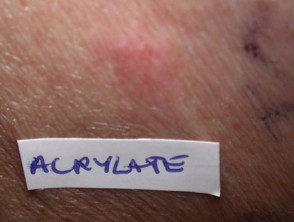
Diagnostic Evaluation: Acrylate Allergic Patch Test
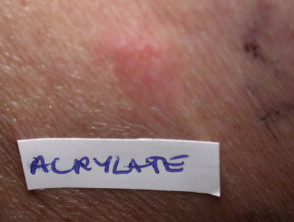
Allergic patch test due to acrylate
What is the Effective Treatment for Acrylate Allergy Dermatitis?
Once acrylate allergy is confirmed, the main treatment consists of rigorous elimination of the causal agent. Additionally, it is managed like any episode of acute acute dermatitis or eczema, which may require the application of topical corticosteroids and the constant use of emollients to restore the skin barrier. topical corticosteroids and the constant use of emollients to restore the skin barrier. emollients and the regular use of emollients to restore the skin barrier.
Prevention and Avoidance Strategies for Acrylate Allergy
Patients diagnosed with acrylate allergy, along with all professionals who handle these monomers, must strictly avoid direct dermal contact with them. Exposure can be significantly reduced through the use of appropriate protective equipment, such as gloves.
It is important to note that methyl methacrylate can penetrate latex and vinyl gloves within minutes, so the use of double gloving is strongly suggested. Gloves made of nitrile offer superior protection and are the most recommended.
Always inform your doctor, pharmacist, dentist, veterinarian, and beautician about your acrylate allergy condition. Your dermatologist dermatologist can provide you with more detailed advice, especially if you have high sensitivity to one or several specific types of acrylates.
Common Alternative Names for Acrylates
To facilitate identification and communication of the allergy, it is helpful to know some of the alternative chemical names under which these compounds appear:
- Methyl methacrylate
- Ethyl acrylate
- 2-Hydroxyethyl Methacrylate (HEMA)
- Triethylene Glycol Dimethacrylate
- Ethylene Glycol Dimethacrylate
- Bisphenol A Glycidyl Methacrylate (BIS-GMA)
- Ethylene Dimethacrylate
- Triethylene Glycol Diacrylate
- Ethyl Cyanoacrylate.
Understanding these names is essential to avoid accidental exposure in daily use products and work environments. Proactive management of your environment drastically reduces the risk of allergic outbreaks.