Understanding Acne Urticata: Symptoms, Causes, and Treatments
The term «acne urticata» is infrequently used in modern dermatological terminology. Historically, it was employed to describe a condition characterized by the appearance of intensely itchy papules (with deep itching), often related to prurigo, primarily affecting the face, neck, and upper trunk (the area known as the «mantle»). It is crucial to emphasize that this condition does not truly constitute acne.
Currently, there is uncertainty as to whether acne urticata represents a unique and well-defined skin disorder. Lesions classified under this name might correspond to a localized manifestation of what is known as compulsive skin picking. Alternatively, those variants confined to sun-exposed areas suggest being a mild form of polymorphic light eruption.
Who is Most at Risk for Acne Urticata?
The clinical description of acne urticata is predominantly associated with middle-aged women. Frequently, these patients report experiencing some degree of stress or anxiety concurrent with the appearance of the lesions.
Investigating the Underlying Causes of Acne Urticata
The exact etiology of acne urticata remains unknown to this day. It is speculated that it might originate from an innate immune reaction within the hair follicle, which would trigger the production of chemical mediators that cause itching. Another hypothesis points to a neuropathic form of innate within the epidermis. follicle follicle, which would trigger the production of chemical mediators that cause itching. Another hypothesis points to a form neuropathic symptoms. of pruritus (itching), or even a psychogenic origin. psychogenic.
Although affected women often report high levels of stress, it is difficult to determine if this stressful factor is the initial cause of the rash rash, or if it is a direct consequence of the intense and constant annoyance caused by the rash.
Distinctive Clinical Features of Urticata Lesions
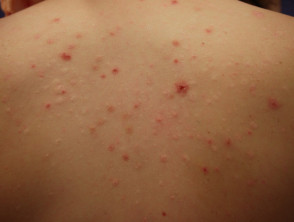
In the clinical picture of acne urticata, the emergence of small bumps (papules), vesicles, and pustules. These lesions are typically located in the aforementioned body areas: face, scalp, neck, upper trunk, and arms. The cardinal symptom is extreme itching, which induces constant scratching or rubbing.
Frequent scratching leads to the formation of unsightly, crusted lesions. Over time, if scratching persists, permanent white scars may develop on the affected skin.
Illustrative Images of Acne Urticata
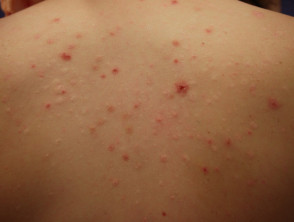
Acne Urticata
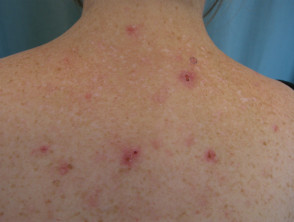
Acne Urticata
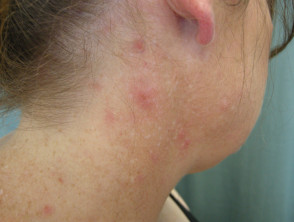
Acne Urticata
Treatment Options for Managing Acne Urticata
Treating acne urticata effectively proves to be a challenge, as this condition tends to persist persist for long periods, even years. However, several therapeutic strategies can offer relief:
- Administration of corticosteroids topical or systemic retinoids.
- Prolonged courses of oral antibiotics, with tetracycline being a common option.
- Ultraviolet light therapy (phototherapy), although it should be avoided if the papules are directly caused by sun exposure.
- Use of tricyclic antidepressants, such as amitriptyline, known for their ability to modulate the perception of skin itching.
- Topical agents Anti-inflammatory agents like methotrexate in resistant cases.
- Implementation of behavioral therapy to help patients reduce the habit of skin picking.
Due to the chronic nature and possible mixed etiology of acne urticata, the most successful treatment plan generally involves a multidisciplinary approach that addresses both the intense physical symptoms and the contributing emotional factors.