
Understanding TCA and the TCA CROSS Technique for Acne Scars
Fundamentals of Trichloroacetic Acid (TCA)
The acronym TCA corresponds to Trichloroacetic Acid. When used in moderate concentrations (usually between 20% and 35%), it functions as a potent chemical peeling agent. Its primary clinical application focuses on improving the texture of aged skin and reducing the visibility of various facial scars.
What Does TCA CROSS Involve and Its Mechanism of Action?
TCA CROSS stands for Chemical Reconstruction Of Skin Scars (Chemical Reconstruction Of Skin Scars). This procedure uses targeted trichloroacetic acid and is commonly performed in outpatient settings. It is specifically designed to treat atrophic scars resulting from acne, valued as a safe, accessible, and effective solution, although results can vary between patients.
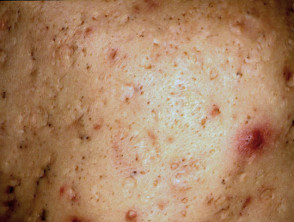
Acne represents a dermatological condition inflammatory common that frequently leaves permanent sequelae. These can manifest as atrophic, hypertrophic scars. or keloid scars, negatively impacting the self-esteem and social interaction of the affected individual.
TCA CROSS treatment requires the precise application of small doses of high-concentration TCA (generally from 70% to 100%) directly onto the indentation of the scar atrophic scar. This localized application causes a controlled inflammatory response that stimulates the production of collagen new collagen. The goal is to improve the dermal profile of the scar, increasing light reflection through collagen regeneration and mitigating shadows caused by depressions. However, it is key to understand that relying exclusively on this method is unlikely to achieve complete correction.
Clinical Indication Criteria for TCA CROSS
The decision to apply the TCA CROSS procedure is based on a comprehensive evaluation that considers several factors:
- The severity and specific morphological type of the present acne scars.
- The realistic expectations and aesthetic preferences communicated by the patient.
- The expertise and clinical judgment of the treating dermatologist.
Specifically, this reconstruction technique is highly beneficial for treating the following subtypes of atrophic scars:
- Ice pick acne scars.
- Rolling acne scars.
- Ice pick acne scars.
Classification of Common Acne Scars
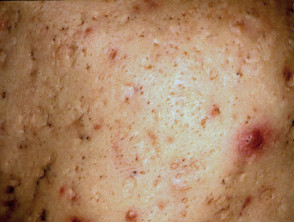
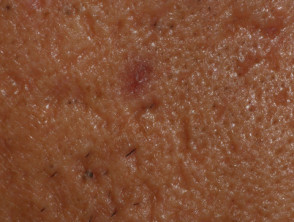
Effective treatment of acne sequelae often requires a multimodal approach. While TCA CROSS addresses indentations in a focused manner, integration with other techniques, such as microneedling, fractional lasers, or subcision, maximizes the chances of achieving a more uniform and satisfactory skin surface.
Qualitative Classification of Acne Scars: The Goodman and Baron System
To ensure objective and consistent comparisons between pre- and post-treatment evaluations, priority is given to using the Goodman and Baron qualitative acne scar classification system to determine severity.
1. Macular Scars
Macular scars manifest as flat marks on the skin, classified by their coloration as erythematous (red), hyperpigmented (brown) or hypopigmented (light). Since they do not represent an alteration of the dermal relief, these marks are the least complex to correct in terms of contour.
Detailed Guide: Scar Classification and TCA CROSS Procedure Execution
Staged Evaluation of Scar Severity
Severity classification is established by considering the visibility of the scars at a common social distance (approximately 50 cm) and the effectiveness of cosmetic or non-invasive methods to conceal or mitigate them.
1. Imperceptible or Minimal Grade Scars
These scars are extremely subtle, often undetectable at a distance, and are easily corrected with light cosmetic makeup or coverage products to standardize skin tone. They represent the least aesthetic impact.
2. Mild Scars (Atrophic or Hypertrophic)
Thin atrophic lesions or slight hypertrophic elevations are not noticeable beyond 50 cm. They can be effectively concealed with makeup or through the shadowing effect generated by shaving facial hair in men (or body hair in non-facial areas). The presence of hair or surrounding hair plays a crucial role in their concealment.
3. Moderate Scars (Atrophic or Hypertrophic)
Moderate lesions are clearly distinguishable at 50 cm or more. Makeup and shadowing from shaved hair are insufficient for complete camouflage. In the specific case of atrophic scars, temporary manual traction of the surrounding skin can offer partial contour correction.
4. Severe Scars (Hypertrophic or Atrophic)
These severe scars are unmistakably visible even at social distances greater than 50 cm. They are resistant to concealment with cosmetics and do not significantly improve with facial hair shadowing or temporary correction by manually stretching adjacent skin.
Methodology for Applying the TCA CROSS Procedure
TCA CROSS (Trichloroacetic Acid Cross-Linking Scar Reconstruction) is a powerfully focused technique, although its application is brief, taking only a few minutes depending on the number of lesions to be treated. To achieve optimal contour elevation results, the treatment needs to be repeated, usually in multiple sessions spaced 2 to 4 weeks apart.
- The patient must be positioned semi-reclined and remain still throughout the application process of the chemical agent.
- Initial skin antisepsis of the area is performed using chlorhexidine or a gauze pad moistened with saline solution..
- A fine, blunt-tipped instrument (similar to a toothpick) is dipped into the Trichloroacetic Acid (TCA) solution, carefully removing excess from the applicator.
- TCA is deposited precisely and punctually directly into the base of the indentation of the selected atrophic scar.
- The instrument removal must coincide with the onset of the "frosting" effect (the superficial whitish appearance), a phenomenon that occurs rapidly (usually within 10 seconds).
- This protocol is sequentially replicated on each of the scars to be treated.
- Controlled cleansing of the skin is performed periodically with gauze pads moistened with saline solution or chlorhexidine.
It is imperative to handle the procedure with maximum caution to avoid any contact with delicate areas such as the eye contour or mucosal surfaces. mucosa. The use of eye protection is mandatory, and immediate availability of equipment for eye irrigation in case of emergency must be ensured. Additionally, individuals who have received systemic retinoid therapy within the last 12 months should be avoided due to the increased risk of alterations during the healing phase. In approximately 25% of patients, it is necessary to add a complementary therapeutic agent to the initial regimen. These additional agents include: systemic in the last 12 months, due to the increased risk of alterations during the healing phase.
Details of the TCA CROSS Procedure for Acne Scar Treatment
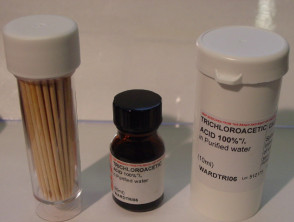
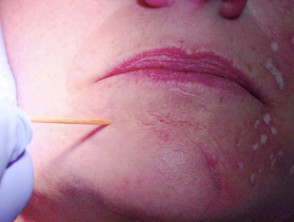
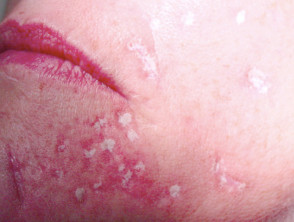
Correct scar classification and strict adherence to the TCA CROSS application protocol are essential to maximize collagen regeneration and ensure effective results in correcting skin imperfections.
Essential Post-Procedure Care After TCA CROSS
Once the TCA CROSS treatment is finished, it is essential that the patient follows the following instructions and warnings to the letter to ensure proper recovery:
- The characteristic white coating or superficial "frosting" of the scar has a limited duration, gradually disappearing over a period of up to 12 hours.
- Expect to experience redness (erythema) and localized swelling, symptoms that typically persist for 24 to 48 hours.
- Approximately between 2 or 3 days, a small scab will develop which, generally, sheds naturally between 3 and 7 days following treatment.
- The patient is permitted to wash the area normally and may apply makeup after the initial review with the specialist.
- Rigorous and constant use of sunscreen is fundamental to significantly minimize the risk of suffering pigmentation post-inflammatory pigmentation.
To optimize improvement in scar appearance, most patients require completing a course including between 3 and 6 TCA CROSS sessions. These treatments should be scheduled with intervals of 2 to 8 weeks, ensuring the therapeutic cycle is completed within a maximum of 6 months.
Possible Complications and Risks Associated with TCA CROSS
Generally, the TCA CROSS technique proves to be a well-tolerated procedure. Serious complications are rare when the treatment is administered by an experienced dermatologist. However, it is important to consider the following potential risks:
- Persistent local irritation and erythema that extends beyond the expected recovery time.
- Accidental injuries in sensitive mucosal areas, such as the lip border, nasal interior, the conjunctiva bacterial resistance infiltrates. Incorrect deposition of the acid can cause painful ulceration, which on rare occasions would leave permanent scarring sequelae.
- Pigmentation alterations following the inflammatory process: one may observe Hyperpigmentation (usually transient in nature) or transient) or hepatitis Hyperpigmentation (the latter may become permanent).
- The Fusing or connections between individual scars that were treated, which could trigger the appearance of larger and more extensive marks.
- An unsatisfactory clinical result or the complete absence of the desired aesthetic improvement in scar texture.
Combined Treatment Options Optimizing TCA CROSS
To enhance the therapeutic response in atrophic scars originating from acne, TCA CROSS integrates perfectly with other dermatological therapies. Compatible and recommended approaches include:
- Topical use of Topical for current use. topical.
- Various Microneedling techniques, such as the application of Dermaroller or Dermapen.
- Treatments performed with laser Fractional laser.
- Complementary minor surgical procedures such as Subcision.
The strategic combination of these therapies frequently yields superior results with a very favorable safety profile.
Prognosis and Expected Results After TCA CROSS
When applied correctly, TCA CROSS is established as a remarkably effective method for addressing atrophic scars resulting from acne. Patients can anticipate significant improvement, calculated between one and two grades on the severity scale of their marks, which will become evident during the six-month follow-up period post-treatment.
It is important to note that patient satisfaction rates tend to be considerably higher when the initial severity grade of the scars was more pronounced before starting the treatment protocol.